It is not all on Ancestry.Com – The Browns in North Dakota
Because of the chasm caused by the missing 1890 census, I had lost track of Henry & Marion (Sanford) Brown (my 2nd great grandparents). Henry and Marion lived in Selene, Michigan in 1882, when Ada was born but nothing else. Certainly Marion was alive in 1884 when she gave birth to their youngest child, Edward in Dakota Territory. But I couldn’t find any direct evidence of Henry after the 1880 census, although I sort of assumed that Edward was his child. If Henry made it to Dakota Territory or if Marion was there alone with some of her other family members, Sanfords, in the Dakota Territory was still a question.
Ancestry.Com has a database, North Dakota, Compiled Census Index, 1870-1890, which I thought would help. The index should be just the thing I needed to figure out what happened to Henry and Marion. It is a “collection contains the following indexes: 1870 Federal Census Index; 1885 Federal Census Index; 1890 Veterans Schedules.” Nothing. Lots of other Browns but nothing showing my Henry, Marion, or their kids and particularly Edward who was born there. Being an index, there is nothing to browse, so I figured maybe the index pages exist elsewhere.
Which told me that besides Ancestry.Com there is somewhere else (Misc.) that has an index. Click that link and I was at the Library, North Dakota State University and their Search the Dakota Territory 1885 Census Index page. A search for Henry Brown, yielded 17 Henry’s but not a one from Michigan. Next, a search for Marion Brown. There she was, right name, right age, right place of birth. It sure looked like her. Clicking on her name brings you to the Census Records Page she is on. Sure enough there she is apparently with her husband “W. H. Brown”, and her 11 children. Henry was a laborer and the family lived in Jamestown, Dakota Territory, in 1885. So the whole family did make it to North Dakota.
I went back to the Ancestry.Com and searched again. No Browns in Stutsman county; none in Wells County nor Kidder County either. I think that there is a problem with the database on Ancestry. It should either have all the counties or identify that database is incomplete. I submitted feedback to Ancestry that the database was incomplete. I’ll report here if I hear anything back.
The 1885 Territorial census gave me new information. Henry Brown was also known as “W. H. Brown” – a clue that may help me find him in other places. The whole family did move to Dakota Territory sometime between 1880 and 1884. In 1885 they lived in Jamestown, Stutsman County, North Dakota. I know the family is spread out over North Dakota, Minnesota, and Montana in 1900.
When researching ancestors, particularly ones that settled a particular location early in that location’s history don’t forget to look for key books regarding the location.
I’ve tried using Google Books first and OCLC’s WorldCat second, but, have found that WorldCat provides fewer false positives in the searches.
I then highlight the title, copy the name and switch windows to books.google.com. Generally, the book is listed on the first page of the google books search. I look at the book there, in particular look to see if an ebook is available. I’m looking for the beautiful “ EBOOK – FREE ” block. If it is there, fantastic. In the search box below the book’s title I enter my desired search criteria, (typically a surname) and look to see if the book has anything I am looking for.
If it is not there, I prefer to see the book myself and not rely upon others to do a lookup for me; so, at this I switch back to WorldCat and get the information I need to order the book/material via interlibrary loan.
Generally, in a couple weeks the book is at my local library where I can closely review the material for information pertinent to my research.
In the case of The History of Wells County, North Dakota, and it pioneers… I received the book in a few weeks and reviewed it closely. there was a nice seven paragraph biography of A. C. Sanford (Almond Sanford). The biography mentions his mother and father (my 3rd great-grandparents), a brother, and sister settled the area with him, at the same time. Almond’s sister married William Wright. William Wright is covered in another biography in the book. I also learned that A.C. had three cousins, Webster, Winfield, and Chas. E., who also settled the area at the same time. Elsewhere in the book, I learned that his uncle, Charles A. Sanford, was a major donor to the University at Jamestown, ND. So much so that a hall was named for him. (Sanford Hall).
I was able to glean 11 source citations and a few dozen facts regarding the Sanfords and the Parsons that settled Wells County, North Dakota in the early 1880s from the book including this regarding my 3rd Great grandfather William Sanford:
“Wm. Sanford and his sons, A. C. and George P. Sanford, located on Section 6 in northwestern Sykeston township in 1883. Wm. Sanford was the father of Mrs. Wm. Wright of Cathay, and a brother of C. A. Sanford of Courtney, donor of Sanford Dormitory at Jamestown College.”
I am certain I will find more information in the three books I still have on request regarding Wells County, N.D., via interlibrary loan. Hopefully, I will learn exactly how Webster, Winfield, and Charles E are related.
The investigation into Ted McAllister’s life has been an interesting process. I started out with very little information, Ted was married, his wife died, later he moved to Savannah where he had “bedded a married woman and was killed by her jealous husband.”
Further stories said that Ted’s brother-in-law went down to Georgia to take care of business and have his body returned to Pennsylvania for burial. The question was, it this all true.
The answer is, yes, mostly. We learned a lot more about Ted and his life and I learned a lot more about genealogical research.
First, Ted’s name was Edward Lamb McAllister.
He married Violet Yellig about 1906. They had three sons, Edward, Albert, & Paul. Violet died in 1910.
Sometime before 1918, Ted married Therisa Bauckmann. They moved from Pittsburgh to Georgia sometime between 1920 and 1924. Therisa died in November of 1924 of a cerebral hemorrhage. There is no mention of Ted’s children in Georgia in any of the documents in Georgia. In 1930 the two youngest boys were living with their grandfather, so I suspect they were with family when Ted died. We don’t know if they were in Pennsylvania before of after Therisa’s death.
Mrs. Bell indicated that they had “lived with Ted for about a month,” which provided the opportunity for Ted and Lillian to get to know each other while Lillian’s husband was at work.
Animosity built between William Bell and Ted over a debt; that Bell said “if [McAllister] ties up my money I’ll kill him.”
Mr. M. H. Bagwell testified that William Bell made statements to the effect that “if McAllister broke up his home he would kill him.”
Wm. and Ted worked at the same place, on different shifts, So Ted would know Bells whereabouts.
Ted was, in fact, murdered in his kitchen, stuck in the back of the head with a hatchet multiple times.
Ted’s youngest brother, Joseph, went to Georgia for the arrangements. Joseph didn’t know that Ted was murdered until he got to Georgia, only that Ted died.
Joseph swore the Arrest warrant for William Bell so he probably had knowledge of the investigation so that he could provide the information to the family.
William Bell seems to have had plenty of motive, however, the police couldn’t tie the hatchet or any other physical evidence to the crime.
Ted was buried in an unmarked grave in “Strangers Ground” Laurel Grove Cemetery.
Conclusion:
Yes, in all likelihood Ted did bed another man’s wife and was murdered for it. And no, Harold didn’t go down to take care of business and ship the body back. Brother Joseph went down and had the body interred in Georgia. Harold may have gone with, but clearly Ted was the principal person involved (signed warrant and death certificate).
Followup:
What happened to Edward Lamb McAllister’s children?
The Chatham County Sheriff’s Office responded to a letter from me indicating that the The Chatham County Police Department was dissolved in 2004. They also indicated that jurisdiction was transferred to the Savannah/Chatham Metropolitan Police Department. I wrote the Savannah/Chatham Metropolitan Police Department requesting more information from them on August 12, 2013 and am yet to receive a response of any kind from them.
Donna plays at the Lavering Theatre – Twin Falls, Idaho – Dec. 1st, 1919
I was unable to find any evidence of Chin Chin playing between November 27th (Thanksgiving) and November 30th. On December 1st, Donna and the Chin Chin cast played in Twin Falls, Idaho.
On November 25th, 1919, one of the oddest advertisements I have seen regarding the show ran in the Twin Falls News. It was an announcement “TO THE GENERAL PUBLIC” regarding the show. I did not see any “articles” (really press releases) regarding the show running.
On November 29th there was a large display ad, which included a photo of Walter Wills and Roy Binder in the paper for the show. On the Nov. 30th and on Dec. 1st there were regular sized ads. The non-paid announcement the paper made was on December 1st under “Amusements”
LAVERING–”Chin Chin”, Charles Dillingham’s musical comedy.
That’s it. No hype, no review following the show. Very odd, it almost seems that the paper didn’t care about either the show or the theatre. I think the theatre’s history sheds some light on the mystery.
E. C. Lavering built a furniture store in Twin Falls in 1908. Six years later, in 1914, he built an “Opera House” next door to his store. The theater appears to have had a very small stage (see photo) and had little room. (Imagine a curtain call on that stage with a cast of 65.) I’m sure the size, the lack of newspaper hype for its shows, and, probably, the facility itself all contributed to the theatre’s downfall. In 1922, it switched to moving pictures only.
1922 was still the era of silent films, short “talkies” didn’t begin until 1923 and the first feature film didn’t release until 1927 (The Jazz Singer).
Lavering Theatre
Courtesy Blacker Furniture
The theater lasted for only three more years. When it was sold in 1925 the new owners intended to level the floor and remodel it. In 1927 it reopened as a skating rink that was next door to “Danceland.” That business must not have done well either, because in 1928 it and the “Danceland” were remodeled to become a Packard dealership. It remained a car dealership for over thirty years. In 1959 it was remodeled again to make Blacker Appliance and Furniture and Appliance store, which stands today. Oddly enough, this is the only building I know of that Donna played in that is still standing. It has been joined to another building, has had an addition made to the side, and appears to have had the two-story stage area in the back removed, but the basic structure is still standing, 99 years later.
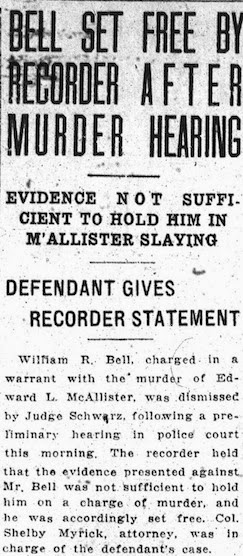
EVIDENCE NOT SUFFICIENT TO HOLD HIM IN M’ALLISTER SLAYING
DEFENDANT GIVES RECORDER STATEMENT
William R. Bell, charged in a warrant with the murder of Edward L. McAllister, was dismissed by Judge Schwarz following a preliminary hearing in police court this morning. The recorder held that the evidence presented against Mr. Bell was not sufficient to hold him on a charge of murder, and he was accordingly set free. Col. Shelby Myrick, attorney, was in charge of the defendant’s case.
Bell’s Statement.
Making his statement to the court. Bell said on December 10 he got paid off in the morning. “Mr, McAllister told me he expected me to pay $5 on the amount I owed him that, pay-day. I told him it was Christmas and I wanted to buy a few thing for my wife and child. I told him. I had an insurance policy and that I intended to borrow some money on it and pay all 1 owed him,” he said. To this, Bell said, McAllister replied: “Bell, when I loaned you boys money I did not intend to punish you, but I want you to pay up, because I may not be abound here long.” In reference to the alleged charge that he carried a weapon after McAllister’s death, Bell said: “I had a pistol, but it was in the pawnshop.”
Preliminary to discharging the prisoner, Judge Schwarz commended the county police for the zeal they had shown in trying to solve a very difficult case, and said there was no reflection on the officers because of his Judgment dismissing the case.
Found Dead
Mr. McAllister was found murdered in his home on Thirty-ninth street near Ash a fortnight ago. He had been brutally slain with a hatchet. County police investigated and several days after the discovery of the murder Mr. Bell was arrested on a warrant sworn out by Joseph McAllister, of Pittsburg [sic], a brother of the dead man.
Showed No Apprehension.
As soon as he was set free Bell shook hands with his counsel, Colonel Myrick, and then went over to where his wife was sitting, just in front of the desk of J. F. Bernhardt, clerk of court. Mrs. Bell arose to greet her husband and the couple locked arms, in a loving embrace.
During the trial of the case Bell was alert, and at times prompted his counsel in an audible voice. When a telling point was made by Colonel Myrick in drawing out testimony favorable to him from a witness, Bell would smile and glance knowingly at Judge Schwarz. At times Belt seemed to enjoy the trial and at no time was any nervousness or apprehension apparent.
McCarthy Testifies.
Chief of Detectives McCarthy, the first witness in the case, told about finding McAllister’s body In the kitchen of his residence. The body was in a sitting posture, with the shoulders against the partition wall and the dead man’s head was leaning to one side. A bloody hatchet was on the kitchen table, A dish of rice and a bowl of coffee, without cream, but with the cream pitcher near, was on the table. McAllister had a fork or spoon in one hand, he said. After finding that McAllister’s house was outside the city limits, Chief McCarthy said he turned the case over to the county policy.
Brown Repeats Story
H. B. Brown told about the same story that he told before the coroner’s Jury. He said he and his wife went to McAllister’s home on the Tuesday the body was found. Looking through the window at the front of the house, he saw McAllister’s bed had been used. He then went around to the, rear of the housed and was then joined by a Mr. Carr, who asked them what they were looking for, and on being told, joined them in looking through the kitchen window. He saw McAllister’s legs. The window was not latched and they raised it up and saw that McAllister was dead, he said. He reiterated his evidence as to finding the hatchet and the position of the body.
Dr. George H. Johnson, the coroner told about visiting the house and examining McAllister’s body. His other evidence was confined to the statement that he found the dead man’s watch was running, and that it continued to run until the next night at 8:45 p. m. Based on this evidence, be gave it as his opinion that McAllister was killed between 8 and 9 o’clock the morning prior to the finding of the body.
Alleged Threats.
M. H. Bagwell of 1911 Price street, who worked at the Atlantic Coast Line shops with Bell and the dead man, testified that Bell owed McAllister money and that on December 24, when the force was about to be paid off he (Bagwell) laughingly said: “Boys, you are not going to get any money today, I see McAllister here.” Bell replied, he said: “if the D — – – – ties up my money I’ll kill him.” The witness said that McAllister had loaned money to the men at the shops but had never garnisheed him, (Bagwell) and it was also admitted that he did not “tie up” the prisoner’s money.
Evidence intended to show that there may have been trouble between the dead man and Bell was limited to a remark. Bagwell said Bell made, to the effect that if McAllister broke up his home he would kill him.
Mr. McCain of 203 York street, east, testified that he was present when Bagwell made the remark about the boys not getting any money and heard the defendant make the remark that he’d kill McAllister if he tied up his money. He said McAllister loaned money to the men at the shops. Asked by the recorder if McAllister charged them interest, the witness said he did not charge him any.
Lived in Macon
Bell resided in Macon about four years ago. He was married to Miss Lillian Lucile McClain on June 19, 1918. Miss McClain resided at Cross Keys at Macon, Prior to her marriage she was employed as a stenographer in Macon. At the time of his marriage Bell was a soldier at Camp Wheeler. He and his wife both have relatives in Macon.