Wills and probate records can provide valuable insight and speculation into family dynamics that I find fun to consider. Such is the case of James Ashley (J.A.) Hobbs (1843-1920).
J.A. Hobbs was a civic leader. He was the Clerk of Superior Court in Williamston, Martin County, North Carolina. He died on 29 November 1920; his wife preceded him in 1913. At the time of his death, he had five living children.
Only three days after his death, on December 2nd, his oldest daughter, Annie E. Armstrong, applied to be the administrator of his estate and indicated that her father died without a will[i]. Also, in that application she mentioned that the five living children, Charles L Hobbs, R.R. Hobbs, J Floyd Hobbs, Mary L. Howell, and herself would be the heirs to the estate. Although Charles would have been the oldest child, Annie applied, and was granted administration of the F. A. Hobbs estate.
About six weeks later, on 14 Jan 1921, a will, dated 10 Sept 1918, was filed with the courthouse[ii]. This will established “friend and lawyer” A. P. Dunning as the executor of the will. In the will, Mary L. Howell was to receive the entire estate, except for $100 to go to A. P. Dunning. Subsequently, Mary L. Howell received everything and the other four children, Charles, RR, Floyd, and Annie received nothing.
Many questions regarding family dynamics come to mind. Was Annie trying to pull a fast one or did she really not know that J.A. had a will? Three days after a person’s death seems to me pretty quick for someone to file in probate court. Why did J.A. write out all of the other children and leave Mary Lillian, his youngest daughter, (who was 33 years old) as his only heir? Were the other four estranged from their father? I wonder if J. A. felt that his other children were doing well enough and didn’t need the support that Mary Lillian needed as the wife of a struggling minister. Many questions we may never know the answer to, but it is fun to speculate and wonder.
TRANSCRIPT – LAST WILL AND TESTAMENT – J. A. HOBBS – 10 SEP 1918
Source: Ancestry.Com – North Carolina, Wills and Probate Records, 1665-1998; North Carolina County, District and Probate Courts., North Carolina, Wills and Probate Records, 1665-1998, Ancestry.com, Wills, 1774-1963; Author: North Carolina. Superior Court (Martin County); Probate Place: Martin, North Carolina – Pages 578 & 579.
North Carolina}Martin County} I, J. A. Hobbs, of the county and state aforesaid, being of sound mind and memory but considering the uncertainty of my earthly existence, to make and declare this my last Will and Testament.
First: My executor herein named shall give my body a decent burial, pay all funeral expenses, together with all my just debts, out of the first moneys which may come into his hands belonging to my estate.
Second: I give, devise and bequeath to my daughter Mary L. Howell, all the property of which I may devised and possessed, both real and personal, of whatever nature, ??? or description and wherever situate, including all money that [Page 579] I may have on hand at the time of my death, all notes and bonds of every kind and all other evidences of debt that may be due me at the time of my death. Also my personal affects, including my gold watch and chain, all my household and kitchen furniture, and also any and all insurance policies of mine regardless as to whom some may be payable in the face or faces thereof, including also, two lots of land situate in Beaufort County in Washington Heights, and any and all other property not above enumerated, of which I may die sized and possessed; it being my express purpose and intention to give, devise and bequeath to my daughter, Mary L. Howell, everything of the shape of property of which I may die dived and possessed to have and to hold to her absolutely and unconditionally forever in fee simple.
Third, I hereby constitute and appoint my friend and lawyer, A. P. Dunning, my executor, to execute this my last Will and Testament according to the true intend and meaning of the same and every fact thereof, hereby revoking and declaring utterly void all other Wills and Testaments by me heretofore made, and in full compensation for his services in executing this my last Will and Testament, I give and devise unto the said A. P. Dunning the sum of $100 one Hundred Dollars.
In witness whereof, I the said J. A. Hobbs, do hereunto let my and and seal this 10th day of Sept. 1918.
J. A. Hobbs {Seal}
———————
Signed, sealed, published and declared by the said J. A. Hobbs to be his last Will and Testament in the presence of us, who at his request and in his presence and in the presence of each other, we subscribe our names as witnesses thereto. A. Hasill L. C. Burnett
Endnotes:
[i] North Carolina County, District and Probate Courts., North Carolina, Wills and Probate Records, 1665-1998, Ancestry.com, Administrators, Guardians Appointments and Records, Accounts, Inventories, Years Support, Executors and Widows Dowers, 1869-1963; Author: North Carolina. Superior Court (Martin County); Probate Place: Martin, North Carolina – Page 218.
[ii] North Carolina County, District and Probate Courts., North Carolina, Wills and Probate Records, 1665-1998, Ancestry.com, Wills, 1774-1963; Author: North Carolina. Superior Court (Martin County); Probate Place: Martin, North Carolina – Pages 578, 579, & 580.
[Guest Blogger Melody Pettus shares a story about her 2nd great grandfather. This is part two of two parts. Photo selections by Don Taylor. Part I is here.]
Dark Shade’s journey among the Strangers brought him to the largest Hearth Home he had ever seen. Chest high posts of wood and sharp ripping thorn-like wires stretched far out in all directions and crisscrossed in different sized marked spaces. Some of these spaces had large four-legged animals (what Dark Shade had been raised calling “Land Kin”) enclosed within them – others were filled with unnaturally straight rows and rows of various crops – what Dark Shade had previously been taught were “Green Brothers,” many that he’d never touched or smelled before during his life with Family.
Many Strangers moved around between these long and thorny Stranger Lines, which had openings between them to allow one to walk without touching their tearing vines. Dark Shade had learned that these were called “gates” and which served to keep the Land Kin and the Green Brothers apart from each other. He found the idea of living separated from the Land still very hard to understand but accepted this as another part of Stranger life to accommodate.
His traveling mate Bart was very excited and told Dark Shade that this could be a good farm to find work and a place to live. They found that the home belonged to a small but strong hearted woman in her late thirties named Sarah Wootten. Ms. Sarah had lost her husband to some battle between Stranger clans. Dark Shade did not quite follow what this event was all about but Bart seemed to be very aware and understood what had happened. Ms. Sarah had previously had other Stranger helpers whose skin was a deeper color much closer to Dark Shade’s own – but the battle had somehow changed something in the relationship between the different colored Strangers and she needed to find new Stranger helpers to keep up with the care of the buildings, the Land Kin and the Green Brothers.
Dark Shade and Bart became part of a large Stranger collective. They learned to set up and mend the slashing Stranger Lines, Dark Shade became skilled at working with horned Land Kin by tying them to a large earth cutting knife called a “plow” and walking them back and forth to dig deep trenches. Drawing patterns across the Land with this tool seemed to make things more ready for the Green Brothers to grow and Dark Shade found he had regained some of the quiet reflective time of his earlier life and he realized how much he had missed this. His back and shoulders grew strong and broad and he began to remember and sing some of the old Family Songs to himself as he worked.
One day – an oddly dressed Stranger appeared at the home. He looked very weak and pale next to the hard working Stranger Family that Dark Shade had been a part of for the past several years. This new Stranger spoke with Ms. Sarah who then asked all the Stranger Family to stop their work and come together at the large home.
She explained to everyone that this Stranger had to count everyone here and write down their names for someone called “The Government.” The Government wanted to know how many people lived in the different towns. Dark Shade didn’t understand why this was so important, but everyone lined up and began telling this new Stranger their names, how many seasons they had seen and what they did for Ms. Sarah.
When Dark Shade gave his name, the Stranger looked puzzled and said that he needed at least two names to mark down in his book. Dark Shade scratched his head and then offered his full name Cloak of Moon-Shadows-Land. This apparently was still not what the Stranger was looking for. Many of the Stranger Family working for Ms. Sarah did not have last names either – so the new Stranger announced that they would all have Ms. Sarah’s last name of Wootten. This took care of one name but did not solve Dark Shade’s issue with his “first name” as the Stranger said he needed what he called a “proper” name. Ms. Sarah suggested a name from a book she read almost constantly called a “Bible” that she thought sounded similar to Dark Shade – Shadrick.
Dark Shade felt very confused over being asked to give up his birth name, but Ms. Sarah assured him that this was a strong name of a brave person whose Faith had allowed them to overcome very difficult times. Dark Shade decided that if he had to be re-named to be with the Stranger community – then this one sounded close enough to his old name and seemed to hold strong Heart values that he didn’t feel he had somehow betrayed his Birth Calling.
Dark Shade eventually left Ms. Sarah’s Stranger Family but kept using the name Shadrick Wootten as he found it much easier to find work using the Stranger society’s way of addressing each other. Over many sun cycles, he retraced his original Walk to see if he could find his Family again but they had left the last place he knew of and no one seemed to know where they had gone. He had always before felt that his Heart Compass was anchored by the thought that his Mother and Father would be there when he was ready to return. With a heavy heart, he then continued his journey in the odd and rule-bound Stranger Society he had gone to explore so many years ago – searching for a Heart and a Hearth that he could once again call “home”…
His Heart moved him to Walk along a large and fierce road of water to a Land named for the brown and powerful Water Road – Mississippi – following the work opportunities and feeling the pull of warmer days. He was happiest when he could feel the earth growing beneath his feet and the Sun and Moon shining on his face. He began to feel it was time to build his own Family to tie his Heart Compass to.
At one of his Stranger jobs – he met a young woman named Mattie who worked inside the Stranger home. Mattie began listening to Shadrick/Shade’s stories and spoke to him for hours afterwards about his life and his Family. They spent many evenings after work was done sitting outside and watching the night sky. Shade told her his Family’s Star Stories and she laughed in delight as the Stars came to life and chased and loved and fought with each other across the dark blue stage of the evening.
She took a fancy to the young melancholy man called “Shade” among the other workers. Shade had never had anyone express an interest in his life. Before-Strangers and felt loved and valued for the first time in many, many sun cycles. Mattie soon found herself mother to a boy and girl from his returned attentions. Shade kept Family as sacred in his Heart and followed the Stranger society’s customs of registering his relationship and attachment to Mattie by a rite they named “marriage”.
Tate, Mississippi was a small and violent Stranger town – plagued by large clans of Oath-Breakers who held the town in fear by brute force. Several of Tate’s Law Keepers lost their lives. Shade was stunned at seeing no respect for Elders or Law Keepers and felt great concern for his Family’s safety. Although he loved the area and Maggie herself was born and raised there – he felt it was more important to move his growing little Tribe to an area he had felt safe in before. So…they pulled together their home and children and made a Land Walk back to the state where he worked for Ms. Sarah – Arkansas.
The work in the area they settled in did not seem steady enough to provide for a family with any degree of comfort. Shade worked hard and this town was definitely quieter than Tate, but he did not feel connected or balanced. At night – he stood under the stars and sang his Life.
Moon Elder had loved Shade from birth and she bent low to hear his Life Song. She lit the sky with her mirrored face – opening the Soul of the man singing below her. “Your place is not far. Let your feet move on the Earth, Let the Sky guide you, let the waters of your Life feel my pull. You stand at a great crossroad – Trust your Heart Compass – it is time to Land Walk again.” Shade heard and his eyes glittered with gratitude.
The town they lived in – called “Beebe Town” was smaller than other town’s Shade had seen but it was a hub of Stranger Guest-Giving trade activity with several Land Walks converging together in the area. Travel to various parts of Arkansas as well as Missouri and Tennessee made for constantly changing Stranger faces. Shade spoke to Mattie of the wisdom given to him by Moon Elder. She shared his need to find Home and Hearth. Shade considered Moon Elder’s words and wondered what Sign he would be given to guide his Family’s Walk. During one of his Thought Trails, he found that he had wandered into the center of town and was standing near the spot where three Iron Horses screamed and scrambled past each other. He saw large piles of black powdery rock piled on their backs and noticed a lot of excitement and activity when these rock bearing beasts came into the town. This must have some real value to the Strangers he thought – where does it come from and how do I follow the trail back to where it came from?
One of the Strangers who had ridden an Iron Horse into town gave Shade a piece of thin paper with fancy lines like ivy tracings on old rocks, pictures of people strutting down the streets with Stranger-Money falling out of their pockets and happy children playing in the streets. The flyer talked about “Krebs Oklahoma” and the many “Coal Mines” that were looking for people to help collect the black powdery rock (which Shade understood now was called “Coal” – in Speaker Talk). The paper said that there was plenty of work for all and as Shade was healthy and had a strong back so he thought this could well be the Heart Home that Moon Elder had spoken to him of where he could raise and grow his Tribe with a community of happy Families.
Krebs Train Station & Locamotive “The Nellie” c. 1880
Photo Courtesy: Krebs Heritage Museum
Shade, Mattie and their children (which had by then been blessed by the birth of Twins – a rare and prosperous event) gathered themselves and road the Iron Horse northward – following Shade’s Heart Compass toward Moon Elder’s Promise. He watched Moon Elder’s face begin to darken and vanish. When her shimmering necklace was all that remained in the sky – Shade took his Family off the Iron Horse at the very next stop, seeing the repeat of his Birth Event as a Sign that here indeed was the home he sought. The sign at the station gave this town’s name as “Krebs – they had made it! As they moved off into the town to find their Home and destiny – Shade kept his Family Traveling Chant firmly in his mind – “I shift like Wind, I shape like Water”…
There is more in the telling of these stories than simple conversation. This is the glue that binds us to who we are, where we came from and what we believe. Often the stories will be told again, embellished and improved, by our children and again by their children – a piece of us passed on for generations to come. The ritual is in the remembering – the remembering is self-revelation.
There have been many articles and blogs regarding the newly available Ancestry.Com Wills and Probate Records. I thought I would give it a try. My goal was to find wills for my Howell/Hobbs project. The Hobbs family lived in Martin County for many years so I decided to search for the surname “Hobbs” in Martin County, North Carolina. I immediately found two that were appropriate for my research. The first one was regarding Mary-Alice’s great-grandmother, Annie Deborah Long Hobbs.
In reading through the will, I was surprised that I didn’t learn anything new, only confirmation of other facts I had known. For example, I knew that four of James Ashley and Annie D. Hobbs’ nine children were alive in 1913 and the will and probate records confirm that. Had I not already had that information, the will and probate record would have been invaluable.
It is interesting, however, to note that Annie indicated she was in “feeble health,” because she signed the will the day before she died.
Amanuensis Monday
Transcription of Will: Annie D. (Long) Hobbs (1846-1913) 16 May 1913
North Carolina}
Martin County}
I, Annie D. Hobbs, of the state and county aforesaid, being of sound mind and memory, and being in feeble health do hereby make and declare this to be my last will and testament.
Item 1. I give and bequeath to my daughter Mary L Howell my state Bond of Five Hundred Dollars.
Item 2. I give and devise to my daughter Annie Armstrong, my son’s, Roland R. Hobbs and James F. Hobbs, the sum of one Hundred Dollars each.
Item 3. I give and devise to my sister, Mary F. Long the sum of One Hundred Dollars.
Item 4. At my death, after paying all necessary expenses of my funeral and the purchase of a lot in the Cemetery at Hamilton as near the burial lot of my aunt, Arrista Bryan as can be purchased, The residue of my estate I give and devise to my beloved husband, J. A. Hobbs for his use and benefit during his life and at his death the same shall be equally divided among my four children, R.R & J. F. Hobbs, Annie Armstrong and Mary L Howell share and share alike.
Item 5. I hereby constitute and appoint my beloved husband J. A. Hobbs, my lawful executor of this my last will and
[page break]
testament to execute the conditions of the same. In testimony of which I hereto set my hand and seal this 16th day of May 1913.
Annie D Hobbs (her mark) (her Seal)
————-
Sealed, signed & declared by Annie D. Hobbs to be her last will and testament, in our presence who at her request and in her presence and in the presence of each other subscribed our names as attesting witnesses thereto.
This May 16-1913
R. J. Peel
A. S. Frassell. [?? name is unclear]
————-
Notes from the Order Papers:
The will was probated in Washington County, although Annie was “late of Martin County.”
EXECUTOR’S OATH was signed by J. A. Hobbs on 20 June 1913.
PROBABE OF WILL – Received and accepted on 20 June 1913.
Application for Letters Testamentary posted 20 June 1913 identified estate worth $600.00 and Parties entitled to property include: Annie F Armstrong, Mary L Howell, R R Hobbs J. F Hobbs, Mary A. Long and J A Hobbs.
Source: North Carolina County, District and Probate Courts., North Carolina, Wills and Probate Records, 1665-1998, Ancestry.com, Martin County Wills, Ca. 1663-1978; Estate Papers, 1831-1916; Index to Estate Records, 1831-1916; Author:North Carolina. Superior Court (Martin County); Probate Place: Martin, North Carolina.
52 Ancestors – Week 92
My second great grandmother, Marion Sanford, was born between 02 Jun 1846 and 01 Apr 1847 in Michigan[i],[ii]. The 1850, 1860, 1870, 1880 and 1885 Dakota Territory census records are all consistent with those dates. She was the first child of William M Sanford and Mary E Parsons[iii]. She had six siblings: Elva P, Almon C, William A, George P, and two whose names are Unknown.
In the 1850 Census she was living in Saline, Washtenaw, Michigan with her parents and a one-month-old “infant” who is most likely a sibling whose name is unknown. Also living with them were J. W. Sanford, age 19, and Charlie Sanford, age 11[iv]. Their relationship is unknown but I suspect they were siblings of William.
It appears that the family moved to Indiana about 1857-58, because her siblings Elva and Elmon (Almon) were born in Michigan; but, her youngest sibling, Willie, whose age was one during the 1860 Census was born in Indiana. The infant from the 1850 census appears to be missing. Interestingly enough, the 1860 Census shows her name as Mary, living in Aurora, Dearborn County, Indiana and she was attending school. She was counted in the census on 01 Jun 1860 in Aurora, Dearborn, Indiana (Attending School)[v].
When she was 19, she married W Henry Brown, son of Benjamin Brown and Eliza Fowler, about 1866 in Michigan[vi].
1. Nettie May Brown was born about 1867 in Michigan[vii].
2. Arthur Durwood Brown was born on 05 Dec 1869 in Saline, Washtenaw, Michigan[viii].
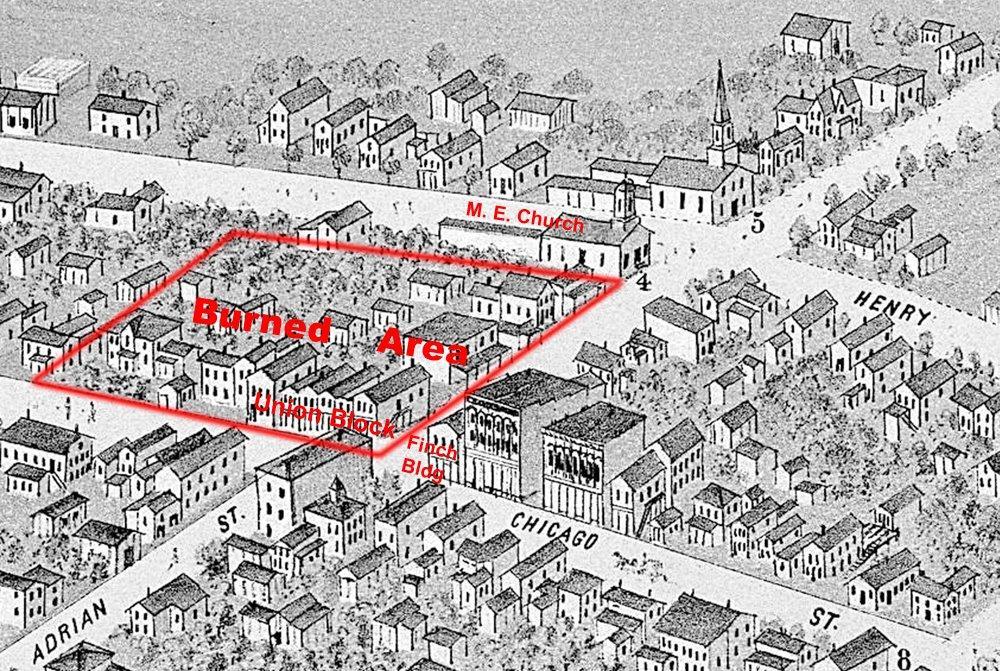
A large fire burned much of downtown Saline May 21st 1881. I wonder if the fire, and it causing the loss of business and customers in Saline contributed to the Browns leaving Saline and moving west, to Dakota Territory sometime between 1882 and 1883[xix].
11. Marion and Henry’s youngest child, Edward Warberton Brown, was born on 31 Jan 1884 in Robinson, Kidder County, North Dakota[xx].
The 1885 Dakota Territory Census indicated that the W. H. Brown family lived in Jamestown, Stutzman County, Dakota Territory[xxi]. Jamestown was founded in 1872 and was a river crossing for the Northern Pacific Railroad. In 1873, Stutzman County became the first county in Dakota Territory. In 1883, Jamestown incorporated as a city and in 1889, North Dakota became a state. So, the Brown family were settlers in the Dakota Territory and many of them were still in North Dakota when it became a state.
I have been unable to find either Marion or her husband W Henry Brown in any records after 1885, so I have no death or burial information regarding Marion. By 1900, the children of Henry and Marion appear to have disbursed. Their youngest, 16 year-old Ed, was staying with Charlotte Sanford, the widow of his first cousin, once removed, so I suspect that both Marion and Henry had died by then.
Endnotes:
[i] 1860 United States Federal Census (A), Ancestry, https://www.Ancestry.com, 1860 – Indiana, Dearborn, Aurora, Page 420, Dwelling 220 – Wm Sanford.
[iii] History of Washtenaw County, Michigan: Together with Sketches of Its Cities, Villages and Townships… (1881), Pg 1409. Imgage, Google Books (https://books.google.com/books?id=2z0XAQAAMAAJ).
[v] 1860 United States Federal Census (A), Ancestry, https://www.Ancestry.com, 1860 – Indiana, Dearborn, Aurora, Page 420, Dwelling 220 – Wm Sanford.
[vi] Speculation. Marian’s first child was born in 1867 when she was 20. I guess-timate she and Henry were married about a year earlier when she was 19.
[xii] Department of Vital Records, Michigan, Births, 1867-1902 (Lansing, MI, ), Family Search, Almond Brown, 01 Apr 1873. https://familysearch.org/pal:/mm9.1.1/nqn7-56v.
[xiii] World War I Draft Registration Cards, 1917-1918, Ancestry, https://www.Ancestry.com, Registration State: North Dakota; Registration County: Kidder; Roll: 1819445, Page 113 of 141.
[xiv] 1880 Census, Ancestry, https://www.Ancestry.com, Year: 1880; Census Place: Saline, Washtenaw, Michigan; Roll: 609; Family History Film: 1254609; Page: 276B; Enumeration District: 237; Image: 0034.
[xv] 1900 Census (A) (National Archives and Records Administration), Ancestry, https://www.Ancestry.com, Year: 1900; Census Place: Wells, Wells, North Dakota; Roll: T623_1234; Page: 10A; Enumeration District: 214.
[xvi] Department of Vital Records, Michigan, Births, 1867-1902 (Lansing, MI, ), Family Search, Fred Brown, 25 Jan 1878. .
[xvii] 1880 Census, Ancestry, https://www.Ancestry.com, 1880; Census Place: Saline, Washtenaw, Michigan; Roll: 609; Family History Film: 1254609; Page: 276B; Enumeration District: 237; Image: 0033 AND Image: 0034.
[xviii] Department of Vital Records, Michigan, Births, 1867-1902 (Lansing, MI, ), Family Search, Adia Brown, 01 May 1882.
[xix] Speculation: Adia was born in 1882 in Michigan and Edward was born in North Dakota in January 1884.
I don’t typically use other people trees for facts or relationships. Rather, I like to use other trees as a sort of reality check. If I see that other researchers have the same determination of facts that I have, I figure I’m on track. If I see other researchers have reached different conclusions, then I know that I need to review and double-check my facts and decisions regarding the individual. My second great grandfather Henry Brown required such a review and double-check. Pretty much everyone is in agreement regarding his wife, Marian Sanford. However, an Ancestry search for Arthur Durwood Brown (my great grandfather) brings up sixteen trees that include his parents. Ten of those Trees indicate Arthur’s father as Henry Mack Brown, one indicates William Henry Brown, one indicates Henry William Brown, and four indicate just Henry Brown.
All ten of the Henry Mack Brown selections indicate a birthdate in 1845 and all of the other Henry Browns indicate a birth year of 1842 or 1843. Learning of these differences cause me to reanalyze my finding and make sure I’m on the right path.
None of the other researchers appear to have a birth record for Henry Brown. The birth date and location appears to be deriving their birthdates from census records, a Michigan death record Index, and other family trees. I dismiss other family trees as fundamentally unreliable. It is too easy to accept other people work without taking time to consider the implications of that selection. Next are the census records. The closer the census record is to the original date, the better the answer typically is. I was able to find Henry in the 1850 census where he was seven[i] and in the 1860 census, where he was 17. In both cases he was living in Vernon, Shiawassee County, Michigan a 50 miles north of Washtenaw county where Marion Sanford grew up. In the 1850 Census, Henry Mack Brown appears to have been in Genesee County and appears to stayed in Genesee County and married Jane Gregory in 1886. Meanwhile, my Henry Brown married Marion Sanford about 1866 and lived in Saline, Washtenaw County. The key differentiator between my Henry Brown and others is about 1885 my Henry moved to North Dakota with the entire family. [ii] The North Dakota Census Index shows the entire family in North Dakota (See: https://library.ndsu.edu/db/census/family?ed=44-018-10) and shows Henry as W. H. Brown; but all the children are there at the right ages. I have been unable to find either a death record or a 1900 Census record for either Henry or his wife Marion. I suspect that both of them died between 1885 and 1900 (he would have been 58 in 1900). Therefore, I need to trace all of the children and see if they show up with either Henry or Marion with them in 1900.
I am certain that Arthur Durwood Brown’s father was not Henry Mack Brown. I am also certain that Henry William Brown is a different person for other reasons.
Two William H Browns Enlisted in Company E
William H. Born 30 Jul 1842-29 Jul 1843 is likely right.
William Henry born 20 Jul 1844-19 Jul 1845 not likely.
William Henry Brown is still a likely possibility for Henry Brown’s full name. I am sure that my Henry was enumerated as W. H. Brown in the 1885 Dakota Territory census. The one person that William Henry Brown appears to have based the name upon a William H Brown who enlisted in the Civil War, Company E, 4th Cavalry, Michigan Volunteers. I definitely need to research that name much more. As a Civil War Veteran, there may be much more information regarding his service.
So why the confusion? Certainly, Henry Brown is a common name. In addition, his age changes during the 1870 census.
Henry Brown’s age during various census records:
Census Year
Age
Suggested Birth
1850
7
2 Jun 1842 – 1 Jun 1843
1860
17
2 Jun 1842 – 1 Jun 1843
1870
25
2 Jun 1844 – 1 Jun 1845
1880
37
2 Jun 1842 – 1 Jun 1843
1885
41
2 Apr 1843 – 1 Apr 1844
Derived birthdate
2 Apr 1843 – 1 Jun 1843
Red=Outlayer – Green = Derived
So, what do I do with this information? I add a note in the individuals record to remind me of the things I’ve determined. In Henry’s case, I’ve added the following:
· DO NOT CONFUSE with Henry T and Marion Brown of St. Clair Michigan.
· DO NOT CONFUSE with Henry Mack Brown – 10/21/1845 – 03/09/1906
· DO NOT CONFUSE with Henry W. Brown (b. 1843) of Saline, Washtenaw, whose father was Daney (born in NY) and mother was Mary E (born in New Jersey). Both of W. Henry Brown’s parents were born in New York.
Under my future tasks I added
· Investigate William H Brown who enlisted in Company E, Michigan 4th Cavalry Regiment on 28 Aug 1862 and mustered out on 08 Jul 1865 at Detroit, MI.
· Follow all of W Henry & Marion Brown’s children from 1885 to 1910 and see if Henry or Marion show up anywhere.
Endnotes:
[i] United States Census, 1850, Family Search, Benjamin Brown. https://familysearch.org/pal:/MM9.1.1/MF8G-92R.