The investigation into Ted McAllister’s life has been an interesting process. I started out with very little information, Ted was married, his wife died, later he moved to Savannah where he had “bedded a married woman and was killed by her jealous husband.”
Further stories said that Ted’s brother-in-law went down to Georgia to take care of business and have his body returned to Pennsylvania for burial. The question was, it this all true.
The answer is, yes, mostly. We learned a lot more about Ted and his life and I learned a lot more about genealogical research.
First, Ted’s name was Edward Lamb McAllister.
He married Violet Yellig about 1906. They had three sons, Edward, Albert, & Paul. Violet died in 1910.
Sometime before 1918, Ted married Therisa Bauckmann. They moved from Pittsburgh to Georgia sometime between 1920 and 1924. Therisa died in November of 1924 of a cerebral hemorrhage. There is no mention of Ted’s children in Georgia in any of the documents in Georgia. In 1930 the two youngest boys were living with their grandfather, so I suspect they were with family when Ted died. We don’t know if they were in Pennsylvania before of after Therisa’s death.
Mrs. Bell indicated that they had “lived with Ted for about a month,” which provided the opportunity for Ted and Lillian to get to know each other while Lillian’s husband was at work.
Animosity built between William Bell and Ted over a debt; that Bell said “if [McAllister] ties up my money I’ll kill him.”
Mr. M. H. Bagwell testified that William Bell made statements to the effect that “if McAllister broke up his home he would kill him.”
Wm. and Ted worked at the same place, on different shifts, So Ted would know Bells whereabouts.
Ted was, in fact, murdered in his kitchen, stuck in the back of the head with a hatchet multiple times.
Ted’s youngest brother, Joseph, went to Georgia for the arrangements. Joseph didn’t know that Ted was murdered until he got to Georgia, only that Ted died.
Joseph swore the Arrest warrant for William Bell so he probably had knowledge of the investigation so that he could provide the information to the family.
William Bell seems to have had plenty of motive, however, the police couldn’t tie the hatchet or any other physical evidence to the crime.
Ted was buried in an unmarked grave in “Strangers Ground” Laurel Grove Cemetery.
Conclusion:
Yes, in all likelihood Ted did bed another man’s wife and was murdered for it. And no, Harold didn’t go down to take care of business and ship the body back. Brother Joseph went down and had the body interred in Georgia. Harold may have gone with, but clearly Ted was the principal person involved (signed warrant and death certificate).
Followup:
What happened to Edward Lamb McAllister’s children?
The Chatham County Sheriff’s Office responded to a letter from me indicating that the The Chatham County Police Department was dissolved in 2004. They also indicated that jurisdiction was transferred to the Savannah/Chatham Metropolitan Police Department. I wrote the Savannah/Chatham Metropolitan Police Department requesting more information from them on August 12, 2013 and am yet to receive a response of any kind from them.
Donna plays at the Lavering Theatre – Twin Falls, Idaho – Dec. 1st, 1919
I was unable to find any evidence of Chin Chin playing between November 27th (Thanksgiving) and November 30th. On December 1st, Donna and the Chin Chin cast played in Twin Falls, Idaho.
On November 25th, 1919, one of the oddest advertisements I have seen regarding the show ran in the Twin Falls News. It was an announcement “TO THE GENERAL PUBLIC” regarding the show. I did not see any “articles” (really press releases) regarding the show running.
On November 29th there was a large display ad, which included a photo of Walter Wills and Roy Binder in the paper for the show. On the Nov. 30th and on Dec. 1st there were regular sized ads. The non-paid announcement the paper made was on December 1st under “Amusements”
LAVERING–”Chin Chin”, Charles Dillingham’s musical comedy.
That’s it. No hype, no review following the show. Very odd, it almost seems that the paper didn’t care about either the show or the theatre. I think the theatre’s history sheds some light on the mystery.
E. C. Lavering built a furniture store in Twin Falls in 1908. Six years later, in 1914, he built an “Opera House” next door to his store. The theater appears to have had a very small stage (see photo) and had little room. (Imagine a curtain call on that stage with a cast of 65.) I’m sure the size, the lack of newspaper hype for its shows, and, probably, the facility itself all contributed to the theatre’s downfall. In 1922, it switched to moving pictures only.
1922 was still the era of silent films, short “talkies” didn’t begin until 1923 and the first feature film didn’t release until 1927 (The Jazz Singer).
Lavering Theatre
Courtesy Blacker Furniture
The theater lasted for only three more years. When it was sold in 1925 the new owners intended to level the floor and remodel it. In 1927 it reopened as a skating rink that was next door to “Danceland.” That business must not have done well either, because in 1928 it and the “Danceland” were remodeled to become a Packard dealership. It remained a car dealership for over thirty years. In 1959 it was remodeled again to make Blacker Appliance and Furniture and Appliance store, which stands today. Oddly enough, this is the only building I know of that Donna played in that is still standing. It has been joined to another building, has had an addition made to the side, and appears to have had the two-story stage area in the back removed, but the basic structure is still standing, 99 years later.
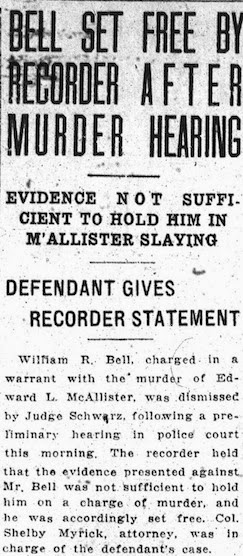
EVIDENCE NOT SUFFICIENT TO HOLD HIM IN M’ALLISTER SLAYING
DEFENDANT GIVES RECORDER STATEMENT
William R. Bell, charged in a warrant with the murder of Edward L. McAllister, was dismissed by Judge Schwarz following a preliminary hearing in police court this morning. The recorder held that the evidence presented against Mr. Bell was not sufficient to hold him on a charge of murder, and he was accordingly set free. Col. Shelby Myrick, attorney, was in charge of the defendant’s case.
Bell’s Statement.
Making his statement to the court. Bell said on December 10 he got paid off in the morning. “Mr, McAllister told me he expected me to pay $5 on the amount I owed him that, pay-day. I told him it was Christmas and I wanted to buy a few thing for my wife and child. I told him. I had an insurance policy and that I intended to borrow some money on it and pay all 1 owed him,” he said. To this, Bell said, McAllister replied: “Bell, when I loaned you boys money I did not intend to punish you, but I want you to pay up, because I may not be abound here long.” In reference to the alleged charge that he carried a weapon after McAllister’s death, Bell said: “I had a pistol, but it was in the pawnshop.”
Preliminary to discharging the prisoner, Judge Schwarz commended the county police for the zeal they had shown in trying to solve a very difficult case, and said there was no reflection on the officers because of his Judgment dismissing the case.
Found Dead
Mr. McAllister was found murdered in his home on Thirty-ninth street near Ash a fortnight ago. He had been brutally slain with a hatchet. County police investigated and several days after the discovery of the murder Mr. Bell was arrested on a warrant sworn out by Joseph McAllister, of Pittsburg [sic], a brother of the dead man.
Showed No Apprehension.
As soon as he was set free Bell shook hands with his counsel, Colonel Myrick, and then went over to where his wife was sitting, just in front of the desk of J. F. Bernhardt, clerk of court. Mrs. Bell arose to greet her husband and the couple locked arms, in a loving embrace.
During the trial of the case Bell was alert, and at times prompted his counsel in an audible voice. When a telling point was made by Colonel Myrick in drawing out testimony favorable to him from a witness, Bell would smile and glance knowingly at Judge Schwarz. At times Belt seemed to enjoy the trial and at no time was any nervousness or apprehension apparent.
McCarthy Testifies.
Chief of Detectives McCarthy, the first witness in the case, told about finding McAllister’s body In the kitchen of his residence. The body was in a sitting posture, with the shoulders against the partition wall and the dead man’s head was leaning to one side. A bloody hatchet was on the kitchen table, A dish of rice and a bowl of coffee, without cream, but with the cream pitcher near, was on the table. McAllister had a fork or spoon in one hand, he said. After finding that McAllister’s house was outside the city limits, Chief McCarthy said he turned the case over to the county policy.
Brown Repeats Story
H. B. Brown told about the same story that he told before the coroner’s Jury. He said he and his wife went to McAllister’s home on the Tuesday the body was found. Looking through the window at the front of the house, he saw McAllister’s bed had been used. He then went around to the, rear of the housed and was then joined by a Mr. Carr, who asked them what they were looking for, and on being told, joined them in looking through the kitchen window. He saw McAllister’s legs. The window was not latched and they raised it up and saw that McAllister was dead, he said. He reiterated his evidence as to finding the hatchet and the position of the body.
Dr. George H. Johnson, the coroner told about visiting the house and examining McAllister’s body. His other evidence was confined to the statement that he found the dead man’s watch was running, and that it continued to run until the next night at 8:45 p. m. Based on this evidence, be gave it as his opinion that McAllister was killed between 8 and 9 o’clock the morning prior to the finding of the body.
Alleged Threats.
M. H. Bagwell of 1911 Price street, who worked at the Atlantic Coast Line shops with Bell and the dead man, testified that Bell owed McAllister money and that on December 24, when the force was about to be paid off he (Bagwell) laughingly said: “Boys, you are not going to get any money today, I see McAllister here.” Bell replied, he said: “if the D — – – – ties up my money I’ll kill him.” The witness said that McAllister had loaned money to the men at the shops but had never garnisheed him, (Bagwell) and it was also admitted that he did not “tie up” the prisoner’s money.
Evidence intended to show that there may have been trouble between the dead man and Bell was limited to a remark. Bagwell said Bell made, to the effect that if McAllister broke up his home he would kill him.
Mr. McCain of 203 York street, east, testified that he was present when Bagwell made the remark about the boys not getting any money and heard the defendant make the remark that he’d kill McAllister if he tied up his money. He said McAllister loaned money to the men at the shops. Asked by the recorder if McAllister charged them interest, the witness said he did not charge him any.
Lived in Macon
Bell resided in Macon about four years ago. He was married to Miss Lillian Lucile McClain on June 19, 1918. Miss McClain resided at Cross Keys at Macon, Prior to her marriage she was employed as a stenographer in Macon. At the time of his marriage Bell was a soldier at Camp Wheeler. He and his wife both have relatives in Macon.
After the two nights in Salt Lake City, the “Chin Chin” company packed up and headed to Ogden, UT, only 35 miles or so, to play at the Orpheum Theater.
The Ogden Standard 22 November 1919
Pre-show hype began on November 18th with a paragraph in the “Theaters” column which said, “Manager Goss announced today he has booked “Chin Chin.” the musical comedy event of the season, which with its company of 65 people, will be here on thanksgiving eve. Charles Goettier, business manager of the show, was in Ogden Sunday, completing arrangements for the company’s appearance.”
The paper on Friday the 21st saw the first advertisement for the show coming to the Orpheum. There was also a short advertising article about “Chin Chin Comes to Orpheum.” In the paper of the 22nd, there was a larger display ad for “Chin Chin”, an advertising article, and the now familiar photo of the “Four French Dancing Dolls.” The Ogden Examiner also ran several articles regarding Chin Chin and included the 16 women photo we’ve seen elsewhere.
The Ogden Standard – November 24, 1919
On November 24th, the Ogden Standard ran a new (for us) photo, this time of “The Four Chinese Blossom Girls.” Unfortunately, the quality of the photo is again insufficient to be sure if Donna is there or which one is Donna. I believe that the two middle women are other people but Donna could be either end person. Hopefully, we will find a better image of the four another time.
—
Apparently there was extremely bad weather the night of the show. Depending upon which paper you read it was either a gale or a blizzard. In either event the Ogden audience wasn’t daunted by the weather.
“CHIN CHIN” DRAWS GOOD CROWD TO THE ORPHEUM THEATRE
Ogden Examiner – Nov. 27, 1919
“Chin Chin” an oriental fantasy, gorgeous in its investiture and colorful settings attracted a good house in the Orpheum theatre last night, dispute the gale that blew on the outside. There were lots of girls, some beautiful and some just girls, but ensemble they made a good impression as their voices blended harmoniously. The costuming showed discriminating taste — Charles Dillingham’s hand plain enough — and the __??__ went over with a bang, but—- And here’s the fly In the ointment– did you ever go up to a soda fountain and asks for a gin fizz or something like, and when you tasted it found that the dispenser forgot to put in the “fizz,” the drink was flat, you know. Well, that was just the matter with this production of “Chin Chin,” the dispenser forgot to put in the fizz –the seasoning was a little short.
However, on the whole, the show went by good after the f!r«t act, and picked up well just about the time the clown band got going strong.
There is practically no plot to the variegated performance. In the first act there were Aladdin and Violet Bond, a charming young American girl who drops in Pekin in search of a magical lamp, and the action is centered about her adventurer.
Carlton Reiger, well known in Ogden since he first came here with “Mickey” last summer was Aladdin. He joined the show in Denver and despite the short time has been with the show gave a creditable performance. He had a good lead voice and really was one of the shiny spots in the show.
Roy Binder and Walter Wills were the two dashing comedians who did extremely well in their specialities.
Others who carried their parts better than average were Donna Montran as “Goddess of the Lamp,” Neva Larry as “Sen Sen” and Irene McKay as “Fan Tan,” and Ethel Lawrence as the “American Girl.” Both Miss Montran and Miss Lawrence have pleasing voices.
The Teddy Bear dance was an Irish number and the clown saxophone band was the hit of the evening.
Popular song hits of the evening were: Violet,” “The Gray Moon,” “Love Moon,” “Go Gar Gig Gang Jur,” and “Good-bye Girl.”
Manager J. P. Goss announces Chaundey Oleoit in “Mascushla” on December 3, his first appearance here in ten years
The Ogden Standard also ran a short review. On Nov 28th they said:
“Chin Chin: Seen by Large Number At Orpheum
Despite a very bad blizzard a large attendance was registered at the Orpheum theatre Wednesday night to witness the performance of the musical melange “Chin Chin.”
Unfortunately, however the production was in now way one to call forth very hearty applause or admiration. Much of the music was very old without being at the same time good enough to be worthy of a long remembrance. The costumes and srake [?] settings were fairly attractive. The singing and acting, with one or two exceptions, were not on high grade.
Roy Binder and Walter Wills were the principal comedians and in most of their work did well.
Carlton Reiger, who appeared here as soloist at the first production of the moving picture, “Mickey” was not seen to advantage in his part. By far the most amusing and interesting items of the performance were contributed by the Saxophone Sextet, whose number would be a considerable headliner by itself on any vaudeville bill.
In extenuation of a poor performance it is to be borne in mind that the artists were most probably suffering greatly from cold on the stage.
The Orpheum Theater
The Orpheum Theater – Photo courtesy Utah State Historical Society
The Grand Opera House in Ogden, Utah, was build in 1890. It was a Romanesque style building with a seating capacity of 1,600 people. In 1909 its name was changed to the Orpheum Theatre after the Orpheum Theater Circuit which was a chain of vaudeville and theaters. The chain ultimately became the RKO – Radio Keith Orpheum.
In 1928 the theater was renovated with new ventilation and sound; the “Jazz Singer,” the first “talkie” played there in June of 1928.
Seating in the theater continued to get smaller and smaller with each renovation; the Film Daily Yearbook said the theatre’s seating was 1,037 in 1950.
It became exclusively a cinema in the 1940s and operated until 1982. In 1983 it was torn down to provide additional parking for the Ben Lomond Hotel.
I almost missed that Chin Chin played at the Grand Theater in Rock Springs Wyoming. But thanks to the Wyoming Newspaper Project’s indexing of the Rock Springs Miner, I was able to learn about that venue.
The Rock Springs Miner apparently was a weekly paper, so information about the show was limited to only two editions. The newspaper on November 14th, included an ad for the show, a brief article about the shows coming, and another photo of “The Four French Dancing Dolls.” The quality of this photo’s image is much better than the one which was in the Colorado Springs Gazette. Uncle Russell, Donna’s son, and I are fairly sure that the woman on the left is Donna.
It appears that Donna is on the left.
Rock Springs Miner – 14 November 1919
Thanks to the Wyoming Newspaper Project
The newspaper on November 21st also included the photo of “The Four French Dancing Dolls” along with an ad and a short write up article. The article also mentions, “There is no leading lady in this organization. Although a number of beautiful women, principals and otherwise, who is to enjoy the place of honor as first favorite is left to the choice of the public.”
The article goes on to say that, “It is estimated that 250,000 people from all points more than one hundred miles from New York have already seen ‘Chin Chin” while it was presented at the Globe Theatre in New York, and now Mr. Dillingham is actually bringing this his only company in its entirety to the Grand Thearte [sic].”
When I first saw the Google Maps photo of the Grand Theater today I was astounded. I couldn’t imagine what the company thought when they came to the Grand Theater. It appeared small, very small. By a quick Google Map view of the theater it appeared to be about 60 feet by 80 feet. It was difficult to imagine that such a small theater could host a cast of over 60 people and still have room for customers.
Then I contacted the good folks at the Rock Springs Historical Society on Facebook and asked them about the Grand Theater. They were kind enough to send a photo they had. Their photo clearly showed additional space in the rear, which probably housed the stage, changing rooms, etc.
What a relief. Back in the day, it held over 300 people. The photo also show a roof element that indicates the building was built in 1914 as a Labor Temple.