They say that a picture is worth a thousand words; well, a good map can be worth ten times that. In my volunteer activities at the Scarborough Historical Society, I had been asked to confirm the locations for Scottaway Hill, Harmon’s Mill, and Mill Creek.
I looked into the society’s families files. The Harmon’s have a nice sized file, but all the documents we have seem to relate to other Harmons in the area (presumably descendants of Samuel Harmon). I looked at some of my other regular sources and found the same quoted information in several locations, “Samuel Harmon purchased several large tracts of land at Scottaway Hill in Scarboro, ME, built a mill on the river there known as Harmon’s Mill, and settled at the place in 1728.”
I thought this should be simple; I had seen the Blue Point and Dunston map from The History of Scarborough, which does a great job of showing where Scottow’s Hill, Harmon’s Mill, and even Harmon’s Landing were. Of course, “the road to Falmouth” is Route 1 today and the R.R. shown on the map is the Eastern Trail today. I double-checked with the society’s curator and she confirmed that Scottaway Hill and Scottow’s Hill are the same place.
1. Assuming the “Blue Point and Dunston” map is correct, Harmon’s Mill should be about 1/3 of the way between Route one and the Eastern Trail along the creek. That would put it right near the ninth hole at Willowdale golf course – behind the Portland Pie Company’s Corporate Headquarters.
My “go to” place for anything dealing with water is the USGS. They have a hydrography map that is incredible. https://viewer.nationalmap.gov/viewer/nhd.htm. Zoom in to the area you are interested in. I like to toggle on layers for Geographic Names, Structures, and Transportation. You can toggle on imagery as well.
2. To confuse things, the USGS map, and some other maps I’ve seen, indicate that Mill Brook is the right hand of the two forks shown on the Blue Point and Dunston map, not the one shown to host the mill. If so, the original site could be anywhere along that right-hand stream. I think this is the least likely scenario, but one that could be considered.
3. Finally, local tradition says that the mill was along the creek that doesn’t show up on any modern maps. Certainly, there is evidence that a creek ran through the area, but because of the development over the centuries there is no evidence of the mill there. Also, this site would be along the way to Harmon’s Landing.
Harmon’s Mill Location
Map by Google – Annotations by Don Taylor
So, if local tradition is correct and Harmon’s Mill was located along Manson-Libby Road, probably about half way to Harmon’s Landing. If so, then Scarborough History is incorrect. That said, three sites are really close to each other; all are within a half-mile circle and are within 1/2 to 1 mile from Scottow Hill. I may never know, for certain, where Harmon’s Mill was exactly, but to know that it existed and to know it was an important business in Scarborough 250 years ago is the important thing.
If you have evidence supporting that Harmon’s Mill was at one of these or some other location, I’d love to hear from you. I would like to know where Harmon’s Mill was, and I know the descendants of Samuel Harmon would love to learn where it was also.
Well, at least they did back in the 19th century. My second great-grandfather, Asa Ellis Roberts, came from a large family. He was one of at least 16 children. He too, had 16 children, 12 with his first wife and another four with his second wife. A father, farmer, and Civil War veteran, he led a hard life.
Asa Ellis Roberts was born on 28 February 1835 in Roane County, Tennessee.[1],[2] He is the son of John Calvin Roberts (1795-1873) and Elizabeth Blackwell (1796-1867).
Map of Asa Ellis Roberts Life. Born: Roane, TN, Liveed adult life in Southern Illinois. Map developed using Mapline.Com
Acy, as he was probably known of as child[3], was the 12th of 16 children. He grew up in Roane County, Tennessee. Apparently, he did not attend school as he still was unable to read and write according to the 1880 Census[4].
I have a lot of research to do regarding Asa’s childhood. It appears that something tragic occurred in 1848, when Asa was 13. It appears, from other researchers’ information, that five of his siblings, Calvin, David, Elizabeth, George, and John all died that year. There are five of his other siblings that I do not have death dates, so it is possible that even more than five of his siblings died in 1848. Definitely, more research is needed.
Adulthood
Asa married Elizabeth Minerva Toney (1834-1872) on 19 May 1852 in Rowan County, Tennessee.[5] Asa was 17 and Elizabeth was 18. Shortly after their marriage the young couple moved to Illinois where all of their 12 children were born.
William T. Roberts, born about 1853.
George Washington Roberts, was born about 1855 in Jackson County, Illinois; he died in 1902. He married Harriet Shinall sometime before 1895; next he married Hariett Alice Burchell on 24 December 1895.
John G. Roberts, born between about 1856 and died about 1870 at 13 years of age.
Margaret M Roberts was born about 1858. She married William Harvey Porter sometime after 1870.
The 1860 Census found the young family living in Township 5S (Ewing Township), Range 3E, in Franklin County, Illinois. Asa was a farmer, living with him was his wife and four children. His personal property was valued at $15.[6]
Calvin Logan Roberts was born in December 1860. He married Mary Emeline Fryer, next he married Willie Adeline Harrell, then he married Margaret E. (last name unknown).
Civil War Service
On April 12, 1861 the Civil War broke out and Asa joined Company I, 31st Illinois Infantry (Union) on August 15, 1861, at Benton, Franklin County, Illinois.[7]
His company mustered in on 18 September 1861 at Cairo, Alexander County, Illinois.[8] Cairo is the southern-most city in Illinois and the perfect place to begin a campaign against the Confederacy.
The “Dirty First,” as it was known, saw action at the Battle of Belmont on November 7th under the leadership of Brig. General Ulysses S. Grant. The Regiment then captured Forts Henry, Heiman, and Donelson during February 1862. The taking of Fort Donelson was a major victory for the Union. The unconditional surrender of the 12,000-man garrison ensured that Kentucky would remain with the Union. It also provided Grant the nom de guerre of “Unconditional Surrender” Grant. Grant also received a promotion to major general.[9], [10]
Shortly after the battle at Fort Donelson (Feb 1862), Asa entered the hospital for pericarditis (inflammation of the pericardium – two thin layers of sac-like tissue that surrounds the heart). On 23 July 1862 Asa was discharged for “Chronic Pericarditis.”[11] His physical description at discharge was 5’8”, dark hair, gray eyes, with a fair complexion.
After Asa’s Civil War Service
Sarah Angeline Roberts was born on 5 March 1863. She married Daniel Rufus Baltzell.
James Monroe Roberts was born in June 1865. He married Nancy J. Huckshorn.
In 1865 Illinois held a state census which indicated Asa and his family were living in Township 4S, Range 1E, Jefferson County, Illinois.[12]
Then tragedy struck over and over and over again. Three children in a row died as infants, 1866, 1868, and 1869.
The 1870 Census finds the family living in Township 4, of Jefferson County, Illinois. Asa is still a farmer and his personal property value had grown to $400. With him are his wife and six children; William, George, Margaret, Calvin, Sarah, and Monroe. It appears that his son John G Roberts had already passed.[13]
In 1870, John C. Roberts was born. He died in 1873, living only three years.
On 26 May 1872, Asa’s wife, Minerva died. I don’t know if it was as the result of childbirth, but I suspect it was. Because another child was born and died as an infant in 1872.
On 25 August 1872, Asa married Patience Anna Marshall Dean (1845-1919), in Jefferson County, Illinois.[14] Asa was 37 and Patience was the 26-year-old widow of Thomas Dean. Patience had two children with Thomas, Elnora and another child who had passed already.
With John C. Roberts’ death in 1873, that made five children in a row born and died and six children passing within only seven years. Asa’s father, John Calvin Roberts, also died in 1873.
However, Asa and Patience had their first child together Charles Wilson Roberts on 5 July 1873. Charles married Clara Farmer on 29 January 1891.
Rosa Della Roberts was born on 26 May 1875 in Jefferson County. She married James Lawrence Derrington.
Florence Elizabeth Roberts was born on 21 January 1880 in Ewing, Franklin County; she died on 26 October 1948 in Sesser, Franklin County, Illinois at 68. She married Frances Perry Scott on 24 March 1901, next married Spencer. She had 2 children I know of: Nellie and Alfred.
By the 1880 Census, all of the children Asa had with Minerva had moved on and his household in Elk Prairie Township, Jefferson County, Illinois, consisted only of him, his wife Patience, their three children together (Charles, Della, and Florence) and Patience’s daughter from her marriage to Thomas Dean, Elnora Dean.[15]
Hugh Ellis Roberts was born on 2 July 1884 in Jefferson County. He died on 30 August 1908 in Ina, Illinois at the age of 24. He married Clora Dell Scott on 7 October 1900. They had 4 children: Harry, Carrie, Bert, and Mabel.
Asa Ellis Roberts died on 5 October 1886 at the age of 51[16], was buried at Hope Cemetery in Spring Garden, Jefferson County, Illinois).[17]
Further Actions:
Research the death dates for 5 siblings for whom I don’t have dates.
Research the causes of death for the siblings who died in 1848.
Research Asa Ellis Roberts’ Civil War Record, his pension application, and the pension application of his widow, Patience Anna Marshall Dean Roberts.
List of Greats
Hugh Ellis Roberts
Asa Ellis Roberts
John Calvin Roberts
Elias Roberts
ENDNOTES
[1] Note: Chris H. Bailey indicates that Asa was born on Feb 18 and that his father’s bible is what indicated 28 Feb. His date is probably based upon either Asa or Patience’s civil war pension record. I need to research those records closely. That said, his grave marker and other secondary sources are all in agreement as to the 28 February date. [2] Sources: Find-a-Grave / Asa E. Roberts – Memorial# 90772797 [3] Note: He was listed as “Acy” in 1850 Census. – Family Search: 1850 Census / Roane, Tennessee – House Number 1415; John Roberts [4] Family Search; 1880 Census; Winfield, Elk Prairie township, Jefferson Co., Illinois, Sheet 481B, Line 8; Asa Roberts [5] Family Search: Tennessee State Marriages, 1780-2002 / Asa Roberts – Elizabeth Toney. Note: Some researchers suggest that Elizabeth Minerva Toney’s first name was Cynthia. My use of Elizabeth is based upon this marriage record. [6] Family Search: 1860 Census – Township 5 S Range 3 E, Franklin, Illinois, (Page 534) Line 12 [7] Web Source: Illinois State Archives; Illinois Civil War Detail Report / Asa Roberts [8] Web Source: Illinois State Archives; Illinois Civil War Detail Report / Asa Roberts [9] Internet: National Park Service: The Civil War; Battle Detail; Fort Donelson; https://www.nps.gov/civilwar/search-battles-detail.htm?battleCode=tn002 [10] Internet: National Park Service; The Civil War; Battle Unit Details; Union Illinois Volunteers; 31st Regiment, Illinois Infantry; https://www.nps.gov/civilwar/search-battle-units-detail.htm?battleUnitCode=UIL0031RI [11] Chris H. Bailey – “Descendants of John Calvin Roberts & Elizabeth (Blackwell) Roberts of Roane County, Tennessee”; Page 10 (Person 10) Asa Ellis Roberts. [12] Family Search: Illinois State Census, 1865; Township 4S, Range 1E, Jefferson, Illinois – Asa Roberts/ [13] Family Search: 1870 Census – Township 4. Range 3, Jefferson County, Illinois, Line. [14] Source: Illinois, County Marriages, 1810-1934 / Asa Roberts – P. Anna Dean (Patience Marshall) (Other) [15] Family Search: 1880 Census; Winfield, Elk Prairie township, Jefferson Co., Illinois; Sheet 481B, Line 8 – Asa Roberts – [16] Source: Find-a-Grave / Asa E. Roberts – Memorial# 90772797 – Find (Other) [17] Many thanks to Chris H. Baily for his “Descendants of John Calvin Roberts & Elizabeth (Blackwell) Roberts of Roane County, Tennessee.” His research confirmed much of the research I did, provided new insight into Asa Ellis Roberts’ life and the lives and even the existence of some, of his children.
One of the reasons that I enjoy Randy Seaver’s blog, Genea-Musings is that he regularly makes me realize the missing branches I have in my tree leaves have lots more to do on my tree. His recent “Saturday Night Genealogy Fun” asked folks to look at their tree and determine the age of death for their male ancestors. (He had done a similar thing for female ancestors the week before.)
Using Heredis, it is really simple to generate such a report. I clicked on myself, then clicked on Documents/Ancestor Report and the system generated the data. Then I went to Report Export, I selected Excel from several options. After the information exported, the Excel spreadsheet opened automatically.
Because the ahnentafel numbers for the individuals are exported, it is easy to select just the male ancestors by deleting all of the odd numbers. I immediately saw that my 3rd great-grandfather, Enoch Mannin, lived the longest – 88 years. The ancestor who died the earliest was my great-grandfather Hugh Ellis Roberts, who died at an extremely young 24 years of age.
Next, I began seeing my gaps. I have three people with a range of dates for their life. For example, my great-grandfather John F. Montran was born sometime between 1860 and 1875 and died sometime before 1911. So, he could have died at 35 or died at 51 years or anywhere in between; I don’t know.
Then, I realized I have six ancestors for whom I have no death dates. More work.
Finally, I realized I have nine ancestors in the past five generations that I know nothing about. No names, let alone birth or death dates. So, Randy’s challenge reminded me of how much more work I still have to do. But the good news is that I have 11 of my male ancestors identified as to their age at death. Even better, I have eight more this year than I would have had last year (all of my Roberts line.). I even have one more than I would have had last week, So things are definitely looking up.
I love the National Archives website. It is quick and easy to use. Although it doesn’t always yield information about my research subject, when it does, the information is incredible.
Adolph Rode
I was recently researching Adolph Rode as part of my Rode Project. Because of the Census records, I knew that Adolph immigrated about 1912[i], he filed his First Papers sometime before 1930[ii], and he had naturalized before 1940[iii].
Just the fact that he immigrated, and thus was at some point an Alien, is enough for me to check that an individual might have a record at the National Archives. Searching the National Archives Catalog is very easy and something you should do for any immigrants in your research. Just enter the name of the individual in the search box; in my case I entered: Adolph Rode. At the top of the results was “Alien Case File for Adolph Rode.” The results also include the date of birth and the place of birth, so there was no doubt that the record was the Adolph Rode I was researching.
Next, I wondered if there were any other family members with Alien Case files.
Another search, this time for: “Rode” “Alien Case File” returned 20 results. I scanned the names for other family members. The only other familiar name was Adolph’s wife, Louisa. Two records – definitely worth ordering, so I ordered them.
It took a few days to have the records sent from the warehouse to the Archives Office, have the documents scanned, then have the images emailed to me. I had the option to have them USPS mailed to me, but I’d just scan them myself and then wonder what to do with the paper copies I received. (Throwing them out just wouldn’t seem right.)
The documents arrived. Some pages were useless, like the back side to an old computer punch card or the form on the backside of a letter that wasn’t filled out. One document in the package was the treasure trove of information that I was hoping for – a Form AR-2 Alien Registration Form.
Registration of Aliens was required by the Alien Act of 1940 and all who registered between 1 August 1940 and 31 March 1944 used the Form AR-2. I was surprised to see Adolph had a Form AR2 on file. I know when an individual becomes naturalized their A-File is consolidated into their naturalization file. Looking closer at the documents, one of them was about Reinold Rode (Adolph’s son) and identified him as 4 585 609, the same number as his father. It looks as though when Reinold applied for citizenship, they reopened Adolph’s record.
In any event, the Adolph Rode – Alien Case File is a treasure trove of information. There are bits of fun information, such as, Adolph physical description was: 5’2” 165lbs, red hair blue eyes. There is also key new information, such as Adolph entered the US as a passenger aboard the S. S. Barbrasussa on Apr 25, 1913. I also learned he was “called by the draft in Nov. 1918,” which indicates he at least registered, and I learned that his First Papers were received on August 1922 in Madison, Nebraska[iv].
Alien Registration Form – AF-2 – Front
Adolph Rode
Source: National Archives; Alien Case Files; File A4585609
Alien Registration Form – AF-2 – Back
Adolph Rode
Source: National Archives; Alien Case Files; File A4585609
The Alien Case File for Adolph Rode provided what all really great sources should provide:
Easy search function
Access to original documents,
Provide answers to genealogical questions
Provide the basis for fresh inquiries.
Future Actions
Find records regarding Adolph’s arrived in the US aboard the S. S. Barbrarussa.
English, Scottish, and Irish: Generally a nickname referring to the color of the hair or complexion, Middle English br(o)un, from Old English brun or Old French brun. As an American family name, it has absorbed numerous surnames from other languages with the same meaning.[i] The name is from an old adjective meaning ‘brown dark red,’ Old English and OHG. [ii]Read More About This Surname
Geographical
Although only ranked #202 in the world, the surname Brown is ranked #2 in Scotland and Canada, #3 in Australia, and #4 in England and the United States. In the United States, it is surpassed only by Smith, Johnson, and Williams in frequency.[iii]
In the 1840s, the Brown families in the United States were in every state but concentrated in Ohio, Pennsylvania, and New York.[iv]
My Brown Ancestors
#96 – My earliest known Brown ancestor is my 4th great-grandfather, Odel Brown. I know virtually nothing about Odel other than he was probably born about 1773, he married a woman named Jane and had at least two children, David and my 3rd great-grandfather, Barney Brown.
#48 – Barney/Daney Brown was born in New Hampshire about 1814. He married a woman named Mary probably about 1840.[v] Barney and Mary had at least four children, William Henry, Myron O., Alice C., and David V. Brown. Barney/Daney Brown seems to have vanished from the records after 1860 and before 1870, so I believe he died before 1 June 1870.
#24 – William Henry Brown (he apparently went by Henry) was born in 1842 in Michigan. I speculate that he married Marion Sanford in 1866.[vi] They had 11 children that I know of.
Arthur Durwood Brown
Nettie May Brown
Charles Dean Brown
Mary Brown
Almond Brown
Gerome Clifford Brown
William Henry Brown
Clyde Hewett Brown
Frederick Brown
Ada Brown
Edward Warberton Brown
William Henry Brown appears to have died between 1885 and 1900.
Arthur Durwood Brown
#12 – Arthur Durwood Brown was born about 1864 in Michigan. He married Mary Elizabeth Manning in 1891. Arthur and Mary had twelve children:
Clarence Arthur Brown
Clyde Leroy Brown
Victoria Cecelia Brown
Martin Brown
Cora Elsie Brown
Richard Earl Brown (Aka Clifford Durand Brown)
Dorothy Brown
Edward Lewis Brown
Arthur Eugene Brown
Charles William Brown
Delores Sarah Brown
Nettie Mae Viola Brown
Arthur Durwood Brown died on 27 Aug 1928 in Walker, Minnesota.
Richard Earl Brown always carried a hunting knife. Photo: ca. 1953
#06 – Richard Earl Brown was born 14 September 1903 as Clifford Durwood Brown. He had a daughter, my mother, with Madonna (Donna) Montran. He always wanted to marry Donna, but she said, “No.”
He changed his name to Richard Earl Durand and married Dorothy Amanda Wilhelm. Dick, as he was known, and Dorothy had two children. Living Durand and Mary Lou Durand. He married Cecelia Ann Squires in 1975.
Richard Earl Brown died 19 January 1990.
My Direct Brown Ancestors
#96 – Odel Brown (c. 1796-?)
#48 – Barney/Daney Brown (c.1814-c.1860)
#24 – William Henry Brown (1842-c.1895)
#12 – Arthur Durwood Brown (1864-1928)
#6 – Richard Earl Brown (aka Clifford Durwood Brown, aka Richard Earl Durand) (1903-1990)
#3 – My mother – (Now deceased)
#1 – Me – Generation
My known Brown relatives.
My records have 248 direct-line descendants of Barney/Daney Brown identified over nine generations, which is about 5% of my known Brown/Montran family tree. Looking at the Browns another way, I have 144 individuals with the surname of Brown in my Brown/Montran family tree, the most of any surname.
[v] William Henry Brown was born in 1842 and is believed to be the first child of Barney and Mary Brown. Assuming they did marry, that would estimate they married about 1840.
[vi] Marian’s first child was born in 1867 when she was 20. I guesstimate she and Henry were married about a year earlier when she was 19.
Do you have a Brown ancestor? Do you think that ancestor is one of mine? If so, let’s prove it. If you have tested with Ancestry, Family Tree, or 23 & Me, please contact me through the comments field below. If you haven’t tested, I recommend you do so. Either FamilyTreeDNA or Ancestry.Com tests will easily show the genetic connection.
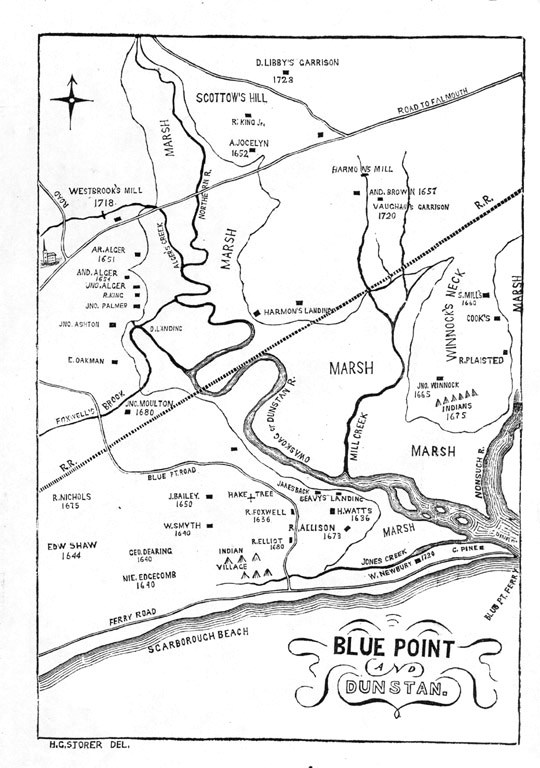 I thought this should be simple; I had seen the Blue Point and Dunston map from The History of Scarborough, which does a great job of showing where Scottow’s Hill, Harmon’s Mill, and even Harmon’s Landing were. Of course, “the road to Falmouth” is Route 1 today and the R.R. shown on the map is the Eastern Trail today. I double-checked with the society’s curator and she confirmed that Scottaway Hill and Scottow’s Hill are the same place.


 By the 1880 Census, all of the children Asa had with Minerva had moved on and his household in Elk Prairie Township, Jefferson County, Illinois, consisted only of him, his wife Patience, their three children together (Charles, Della, and Florence) and Patience’s daughter from her marriage to Thomas Dean, Elnora Dean.


