Blackhurst Conflicts – The “Blacklin” Family of 1860

By Don Taylor

Photo of Don Taylor with cat Nasi.I recently attended a Greater Portland Chapter of the Maine Genealogical Society where the speaker, Pam Stone Eagleson spoke about “Confronting Conflicting Evidence.” It was a very good talk. As I listened to it I was thinking, ‘It doesn’t really apply to me;’ I’m pretty good a reconciling conflicting evidence.’  It wasn’t until sometime later that it hit me, she was talking about “Confronting” and not “reconciling” evidence. Do I really confront contradictions or do I just accept inconsistencies without thinking about them too much?

When I changed software long ago because of a database corruption and because of the shortcomings I’ve experienced in exporting to a GED file and importing a GED file into different software my sources are in a bit of a disarray. Because of that, my practice is to take my original sources and reintegrate them as though they were new sources then delete my old sources as redundant. I was doing that cleanup for my 3rd great-grandfather, Stephen Blackhurst.

I began the walk up from my earliest source citation.

  • 1841 England Census – Good[i]
  • 1850 US Census – Good[ii]
  • 1855 New York Census – Good[iii]
  • 1860 US Census – Whoa Nellie!

My 1860 Census record seemed to come from another planet. Lots of conflicts. Looking at the record from the perspective of having just seen the previous four records provided a new at the conflicts. I decided I need to confront the conflicts head on.

1860 Census[iv]

The conflicts include:

Crop of 1860 Census record for Stephen and Fannie Blackhurst

1860 Census for Stephen & Fanny Blacklin

  • Surname – Blacklin family – Not Blackhurst family
  • Age of Stephen: 60, (b. 1799-1800) verses 1802-1804 of other records (3 to 4 years off).
  • Age of Fannie: 59, (b. 1800-1801) verses 1806-1810 of other records (6 or 7 years off).
  • Married: The box for “married during the past year” is marked. Other records indicate they married in 1825.

Gosh, could I have attributed the wrong family to my tree? I haven’t done that in years.

The kids in the household look to be right for the Blackhurst family.

Sarah is 11, although she should be 12.

Louisa is 22 – Her age is right, but the name is different.  Previous records included her as “Eleazer” and “Ealonr.” I guess I can get “Eleazer” out of Louisa – but “Ealonr”? Maybe there is a middle name I don’t know about yet.

William is the right name and age, 24.

1870 Census[v]

1870 Census – Fanny Blackhurst

Sadly, Stephen died in 1869. The 1870 Census doesn’t show relationships; however, the Fanny Blackhurst family has the right surname – Blackhurst.

Fanny is head of household. Living with clearly is her daughter Louisa, now age 31. It appears that Louisa married during the previous decade and had two children. Husband (unknown Sanders) is absent from the record.

Likewise, daughter Elizabeth, aka Bessie, is living in the house with her husband, Isaac Earl, and a daughter Mary, age 8.

I’ll add that other family members, such as my 2nd great-grandmother Sarah Blackhurst Barber, are living in the same area (Sheridan Township, Calhoun County, Michigan, so I am pretty confident that the Blackhurst family moved from Auburn, Cayuga County, New York, to Sheridan Township, Calhoun County, Michigan, sometime between 1850 and 1860.

Surname Conflict

Going back to look at the conflicts.

I can’t explain the Blackhurst/Blacklin surname conflict. Because the family appears to be consistent with the other records depicting the Blackhurst family, before and after the 1860 Census. I have searched the 1850 and 1870 Censuses for Blacklin families without success.  Also I have searched for the Blackhurst surname in the 1860 census to no avail. I believe I have done a reasonably exhaustive search and believe that the Blacklin surname is a census taker error.

Marriage Conflict

“Married during the past year” is a problem. It is certainly possible that Stephen married a second time to a woman also named Fanny. That would explain the shift in age. Another possibility exists in that the census taker marked people who were married as married in the past year. The first three family units on the page are all marked as marked as married in the past year.

The first household on the page is Thomas Saunders (27) with Marion (24) and two children (5 & 3). The second household on the page is Stephen (65) with Fanny (59) and three children (24, 22, and 11).  The third household on the page is David Bowen (33) Valindima (24) and two children (2 & 1). It just seems odd to me that all three of these apparent family units were married in the past year. Unless I find some compelling evidence elsewhere, I don’t believe that Stephen and Fanny were married in the year previous to the 1860 census or that Stephen was married twice. So again, I believe this is a Census Taker error.

Age Conflict

My experience has told me that ages are most accurate early in life. The ages for children under 10 seem the most accurate.  Women seem to have their birth year increase during their late 20s, 30s, and 40s. In their 50s their birth years seem to return to their original and in their 80s and 90s their birth year often seems to move before their original birth year. Men’s ages seem to go similarly, however, single men in their 50s and 60s seem to be older if they are married and seem to be younger if they are single or widowed.

Stephen appears to fit this model

  • 1841 – Age 39 – b. circa[vi] 1802
  • 1850 – Age 46 – b. circa 1804
  • 1855 – Age 57 – b. circa 1798
  • 1860 – Age 60 – b. circa 1800
  • 1869 – Died – Marker says 1801

Fanny’s ages also fit this model.

  • 1841 – Age 30 – b. circa 1811
  • 1850 – Age 42 – b. circa 1808
  • 1855 – Age 48 – b. circa 1807
  • 1860 – Age 59 – b. circa 1801
  • 1870 – Age 64 – b. circa 1806
  • 1880 – Age 74 – b. circa 1806
  • 1885 – Died – Marker says 1806

Conclusion

The bottom line is that I believe I have confronted the inconsistencies in the facts of the 1860 Census records and the have facts in my database as appropriate. Pam Stone Eagleson’s talk about “Confronting Conflict” led me to further consider some inconsistencies in my tree and that is a good thing. Thank you, Pam.

Sources and Endnotes

[i] 1841 England Census, Ancestry.Com, Yorkshire, Kingston upon Hull, Parish of Holy Trinity, Pages 21 & 22. Stephen Blackhurst.

[ii] 1850 Census (FS) (NARA), Family Search, Stephen Blackhurst – Auburn, Cayuga, New York. Accessed 25 Aug 2013. https://familysearch.org/ark:/61903/1:1:MCT2-GRX.

[iii] 1855 New York Census, Family Search, Stephen Blackhurst – Auburn, Cayuga, New York. Accessed 25 August 2013. https://familysearch.org/ark:/61903/1:1:K675-B3M.

[iv] 1860 Census, Family Search, Stephen Blacklin – Sheridon, Calhoun, Michigan – Line 7. Accessed 25 August 2013. https://familysearch.org/ark:/61903/1:1:MWDJ-W8X.

[v] 1870 Census (FS) (NARA), Family Search, Fanny Blackhurst Head – Calhoun, Sheridan, Michigan, Page 30, Line 24.

[vi] Circa – When I enter a “circa” date, it generally encompasses the year before and the year shown. For example, b. circa 1802 generally means 1801 to 1802. In the example of the 1850 Census which was taken on June 1, 1850, an age of 46 suggests the individual was born between 2 June 1803 and 1 June 1804. On occasion, I also use “About” or “Abt” meaning the same thing.


Posted in Brown-Montran | Tagged , , | 1 Comment

Twelve Darling Greats Discovered

Bright Shiny Objects – A Distraction can be Okay

Howell-Darling-2016 Research
Darling Line

By Don Taylor

Photo of Don Taylor with cat Nasi.The Blizzard of 2017 was a great day to knuckle down and do some genealogy – as long as the power held out. My plan was to find information about Hannah Carpenter, my wife’s 4th great-grandmother. I wasn’t finding anything of interest regarding her. So, I stepped back and began looking at her husband’s (Abner Darling’s) records in more detail. Some time ago, I found a source for information on the Beekman Patent in Duchess County, New York.  It appeared that Abner came out of the Beekman Patent and I needed to research it further to understand how he may have found his wife, Hannah.  So, I looked at that material and became distracted. That document also mentioned a source, a 1913 book, The Darling Family in America, which I found a copy of online. Between the two sources, I extracted the possible names of a dozen Darling ancestors and several dozen siblings of those ancestors.  I learned:

Abner’s parents (My wife’s 5th great-grandparents):

192. Ebenezer Darling (1718-1790)
193. Mary Hakes

Abner’s grandparents:

  1. Benjamin Darling (1687-1772)
  2. Mehitable White (1689-?)
  3. Solomon Hakes
  4. Anna Billings

Half of Abner’s Great-Grandparents

  1. Dennis Darling (c. 1640-1717)
  2. Hannah Francis
  3. Thomas White
  4. Mehitable (?Thornton?)

And even two of Abner’s 2nd Great Grandparents (My wife’s 8th great-grandparents)

1538.  John Francis
1539. Rosa (??)

Wow!  I’ll be the first to admit, abandoning my research on Hannah Carpenter and diving into these Darling materials was going for the bright shiny objects.  I didn’t stay with my research plan. And yes, I “wasted a day” documenting what I found in “The Settlers of the Beekman Patent – Darling Document” and The Darling Family in America. Incorporating that information into a “notional” tree wasn’t part of my research plan for the day. Nothing confirmed, but a great outline to begin working.

We received about 17 inches of snow, had winds over 35 miles per hour for more than three hours, and had visibilities less than a quarter of a mile – an official blizzard. We didn’t lose power, though over 21 thousand people did here in southern Maine.  However, I was able to work most of the day on the Darling Family. I don’t learn anything new about Hannah Carpenter, but that’s okay.  Acquiring the likely names, birth dates, and places of a dozen other ancestors is a good day.  I’ll remember the Blizzard of 2017; it was the day I followed my wife’s Darling line went back to The Great Migration.

Howell-Darling 2017

List of Grandparents

Further Actions / Follow-up

  • Return to Hannah Carpenter and research more about her life.

One more thing, it appears that one of Dennis Darling’s other children, 6th great uncle John Darling, came to Scarborough in the 1600s – a tidbit of information that could keep me involved for days of research at the Scarborough Museum where I volunteer.


Sources:

Doherty, Frank J., “Settlers of the Beekman Patent, The” – File: Darling.doc. See https://settlers-of-the-beekman-patent.myshopify.com/.

Clemens, William M., Darling Family in America, The (1913), Archive.Org.

Posted in Darling-Huber | Tagged , , , , , , | 2 Comments

Collins – Surname Saturday

I don’t really know much about my Collins ancestors, but they are among my earliest ancestors, 8th 9th and 10th great grandparents. They were part of the “Great Migration” of the early 1600s arriving in Massachusetts then locating to Connecticut.

Name Origin

Ancestry.Com suggests that the Collins surname is an Anglicized for of the Gaelic names Ó Coileáin and Mac Coileáin. It also suggests that it is a form of “Coll” a shortened form of Nicholas.[i]

Similarly, Forbears suggests that Collins is derived from and ancestor, “the son of Nicholas” – Coll or Cole – and put into a diminutive form: “Col-in” like “Rob-in.”[ii]

Geography

Collins is the 698th most Common surname in the world; Approximately ¾ of a million people have the Collins surname in the world and about ½ of them are in the United States where the surname ranks 50th.  In terms of density, (percentage of population and rank within a nation) the number one place for the “Collins” surname is Ireland.

Although often thought of as an Irish name, there are more people with the Collins surname in England (and Nigeria) than in Ireland.[iii]

My Earliest Ancestors

I believe that my Collins ancestors came from England. That is to say, I understand that my 8th great-grandmother’s grandfather was Deacon Edward Collins of Bramford, Suffolk, England.[iv] It appears that he came to the Massachusetts Bay Colony about 1637.

His son, Deacon Nathaniel Collins, was probably born in Massachusetts Bay Colony about 1643.[v]

His daughter, Abigail Collins, was likely born in Connecticut Colony about 1682 and married Samuel Wolcott on 27 Dec 1705. I say “understand,” “appears,” “probably,” and “likely” because I have not had the chance to independently verify and confirm the source document from several authored sources individual trees that suggest this information. I have not confirmed with original source documents.

Marker of Abigail Collins Wolcott (1682 - 1758)

Abigail Collins Wolcott (1682 – 1758) – Marker

My third great-grandmother is Fanny Taylor who married Stephen Blackhurst. So the Taylor surname jumped five generations to me. Likewise, I have a niece whose surname is Collins having jumped 12 generations to another descendant being a “Collins.”

Abigail Collins married Samuel Wolcott (1679-1734) in 1705.[vi] They had six children (that I know of); their third child, Samuel (1713-1800) is my 7th great grandfather.

My Direct Collins Ancestors

#6564 – Edward Collins – (1603-1689) – Generation 13
#3282 – Nathaniel Collins (1653-1741) – Generation 12
#1641- Abigail Collins (1681-1758)
#  820 – Samuel Wolcott (1713-1800)
#  410 – Samuel Wolcott (1736-1802)
#  205 – Mary Wolcott (1767-1857)
#  102 – Chester Parsons (1799-1887)
#    51 – Mary Electa Parsons (1828-1888)
#    25 – Marion Sanford (1846-Unk)
#    12 – Arthur Durwood Brown (1869-1928)
#      6 – Richard Earl Brown (1903-1990)
#      3 – My mother – Living
#      1 – me – Living


My known relatives.

My records only have six known Collins, however, I have identified 703 direct-line descendants of Abigail Collins, including my niece over 14 generations, which is almost 1/8 of my known genealogical database.

Footnotes

[i] Internet: Ancestry.com Collins Family History – https://www.ancestry.com/name-origin?surname=collins
[ii] Internet: Forebears – Collins Surname – https://forebears.io/surnames/collins
[iii] Ibid.
[iv] Geni – https://www.geni.com/people/Deacon-Edward-Collins/6000000003221140498?through=6000000001589668526
[v] Geni – https://www.geni.com/people/Deacon-Nathaniel-Collins/6000000001589668526?through=6000000003221140498
[vi] Wolcott, Chandler, HENRY WOLCOTT, The Family of, Internet Archive, Page 066 & 067 – Fourth Generation – XVI – Samuel Wolcott [42].

————- Disclaimer ————

Posted in Surname Saturday, Brown-Montran | Tagged , , | Leave a comment

Digitize those Photos!

By Don Taylor

Photo of Don Taylor with cat Nasi.I advocate digitizing everything that can be digitized, particularly photographs. I was recently speaking with a person at the museum about a photo that she had of the Cunningham family. She showed me the old, faded photo and I asked immediately if it was digitized. I learned it was not. “Oh my,” I said, “we need to fix that.“ I explained the importance of digitizing photos as I went to get the light set for photographing.

Besides the importance of having a backup copy of the photo, electronic versions are easy to share. You can easily send a copy to cousins that may not have the photo. You can also post the photos on-line at many sites including Flickr, Google, Picasa, blogs, and other places to act as “cousin bait.” Finally, electronic versions of a photo may be cleaned up and made much more viewable quite simply and easily.  That is what I suggested to my museum visitor.

I photographed a couple of the larger photos with my camera then scanned a few of the smaller photos with a Flip-Pal.  It does a nice job of scanning photos without needing a computer.

To me, it is important to rename files immediately.  Filenames like DSCN1234 or Scan567 are useless. I know many folks like to use meta data, but I find having key information in the file name is much better. I use the form of, Subject, Context/Action, Place, Source, Date, and Status. I leave out the Place and Source if they aren’t important. That is the date of the image, not the date of the scan.  But, sometimes an image’s date might be something like “c. 1930s.”

Original scan of Charle & Carrie Cunningham & Family (in PNG Format)

In the case of the first photo, I knew that it was a Charles and Carrie Cunningham Family group photo. My guess is that the context might be something like 50th wedding anniversary of them; if so, it would be from 1928. Alternately, the clothes look to be from the early 1930s. So, I’m going to hazard a guess of c. 1930. So, I used the filename Charles & Carrie Cumming with Family – c. 1930.

I use different file extensions for different purposes. I use TIFF format for all my original scans and photographs. I then use JPEG format for all working and shared images. Finally, I use PDF for any images with text after I have run optical character recognition (OCR) on the image. The file types immediately tell me if the image is an original or if it has been edited. Occasionally, I use PNG for original files, particularly if I need to share an original. PNG files use compression to be smaller than TIFF files in size. I use them on images that are particularly large, typically more than 50MB as a TIFF. To give an idea of the various sizes, the following table shows the file sizes for the Charles & Carrie Cumming with Family – c. 1930 file.

TIF/TIFF PNG JPEG/JPG
Uncompressed Lossless Compression Lossy Compression
30.2MB 11.1MB 5.6 MB (Edited)

Next, I open the original file. I use Preview on a Mac.  It is really quick and it is easy to do almost everything I’d like to do. Windows computers have many other photo and/or image products which work very well also. After the file is opened, I immediately export it to JPG format. I then close my TIFF file and open the JPG file. I only ever manipulate or edit the JPG file.

I like to rotate the file and crop the file as appropriate.  If I can leave a ½ in border on the bottom during the cropping process, I do so.

For scanned black and white photos I set the saturation to 0; that eliminates any greens, or other weird colors from the image.  Next, I adjust the image exposure and contrast to provide the best possible image for the faces of the people.  Once I am happy with that image, I raise the sepia to a level that is easier on the eyes than a stark black and white.  Then I save the photo again. Just these few steps only take me about a minute and provides a much higher quality image to use and share, yet maintains the original in an untouched state so the process may be duplicated if desired.

Charles & Carrie Cumming with Family edited.

Charles & Carrie Cumming with Family edited.

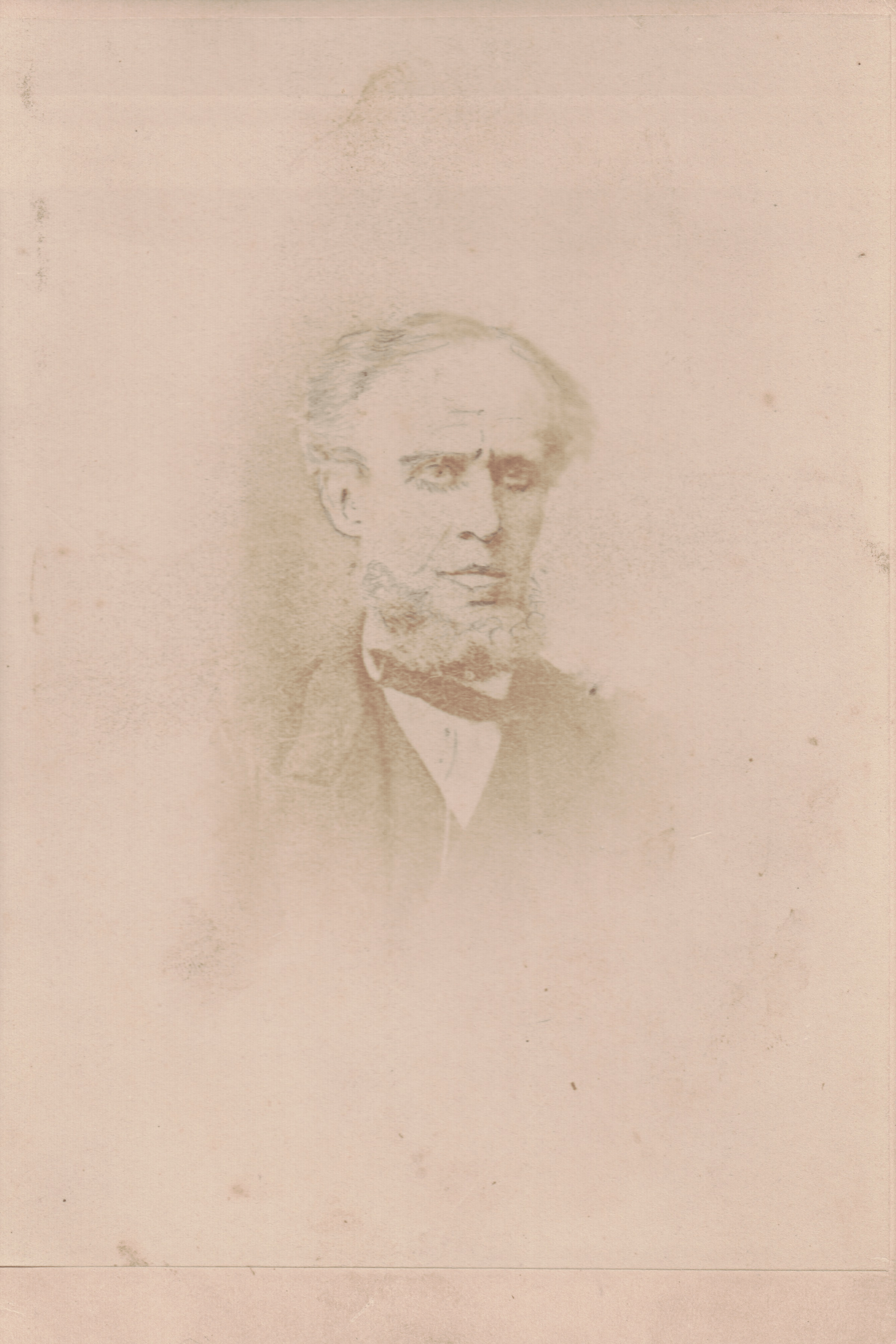
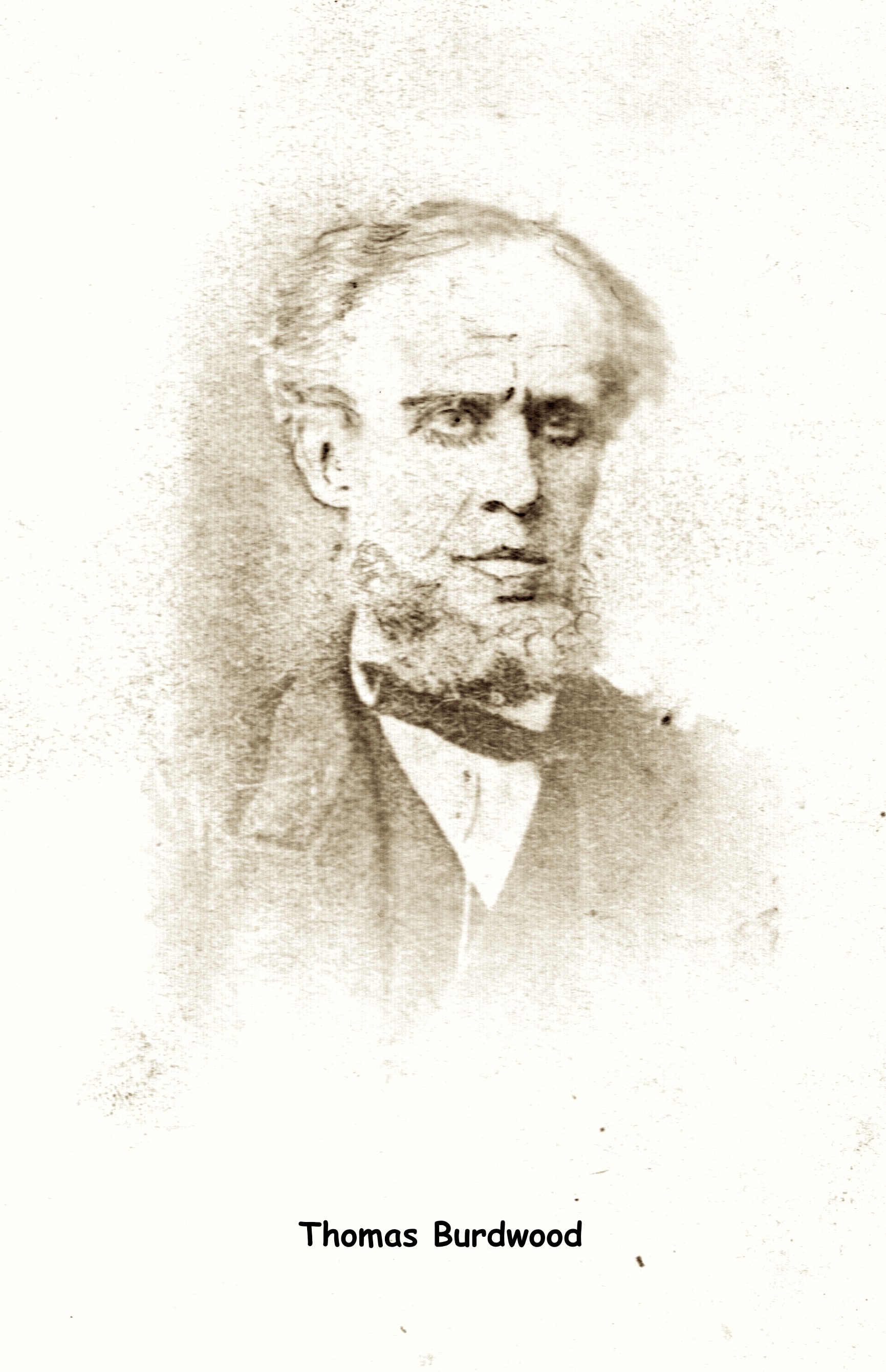
I mentioned earlier about leaving a ½ inch border on the bottom of the photo.  That is to add a caption if possible.  In the case of a photo of Thomas Burdwood, the original was smallish and had aged pinkish over the years. Once again, I duplicated the photo, cropped it, set color saturation to 0, adjusted the exposure and contrast and sepia level.  Once I was done with that, I added text to the image of the individual’s name (based upon what was on the back of the photo) and saved it.

Thomas Burdwood Original Scan

Drawing of Thomas Burdwood

Thomas Burdwood edited

Of course, once a photo has had its initial edit, you can use many other image enhancement tools to remove creases, spots, or otherwise improve the photo.

Scanning photos greatly increase the likelihood that they won’t be lost. Keeping your original scan pristine means you can always return to the original and manipulate the image again. Finally, the manipulated and compressed version not only make the photo nicer to view it makes the image more shareable.

Posted in Scarborough Historical Society and Museum, General Help | Tagged , , , | Leave a comment

New York Times – Rotogravure – 30 June 1918

The Library of Congress has a new collection of The New York Times Rotogravure from World War I.  I was excited to see that the Library of Congress had the same material that I have which meant that I could use it and not need to scan my own collection. The LoC quality was excellent; they had whole pages instead of my partial pages. Then I saw that they don’t have all of the issues.  I looked at my collection and the next one I was going to write about was the June 30, 1918, issue. It isn’t available in the Library of Congress Rotogravure collection. My search of the collection showed they have June 2, June 9, June 16, and June 23, but not June 30, 1918.

Top half of the first of six pages included from teh New York Times, 30 June 1918, Rotogranure

Top half of the first of six pages included from my 30 June 1918 collection. This half of the page includes: “Jitney Tank;” Lieutenant Aviator Leps; Lieutenant Guerin; Lieutenants Reno, Fonck, and Milton; a Shell-Shelter Village; and a Camouflaged French Road. Click the image or here for the OCRed pages.

Oh my — my collection suddenly became much more important. If I have editions that the Library of Congress does not have, then my collection might be unique. If so, I really need to preserve it digitally. Sadly, in the pages that I have for 30 June 1918, one photo was cut out. It affects that page and the reverse side but not the other pages. I photographed all the pages I have from this June 30th 1918 edition. Then I OCRed (used Optical Character Recognition) the images. There is one page that contains a full-page ad for Tintex, but no war photos, so I did not OCR that page and did not include it in my final product.  I assembled the OCRed images into a single Portable Document File. I wish that I had the technology to either photograph the entire image or to be able to adequately stitch the images together; however, I was not happy with the results of my trying to electronically stitch the images.

Here is my attempt with the 30 June 1918 issue.  I hope you find the images and stories as interesting and as fascinating as I do.

Posted in Great War | Tagged , , , , | Leave a comment